
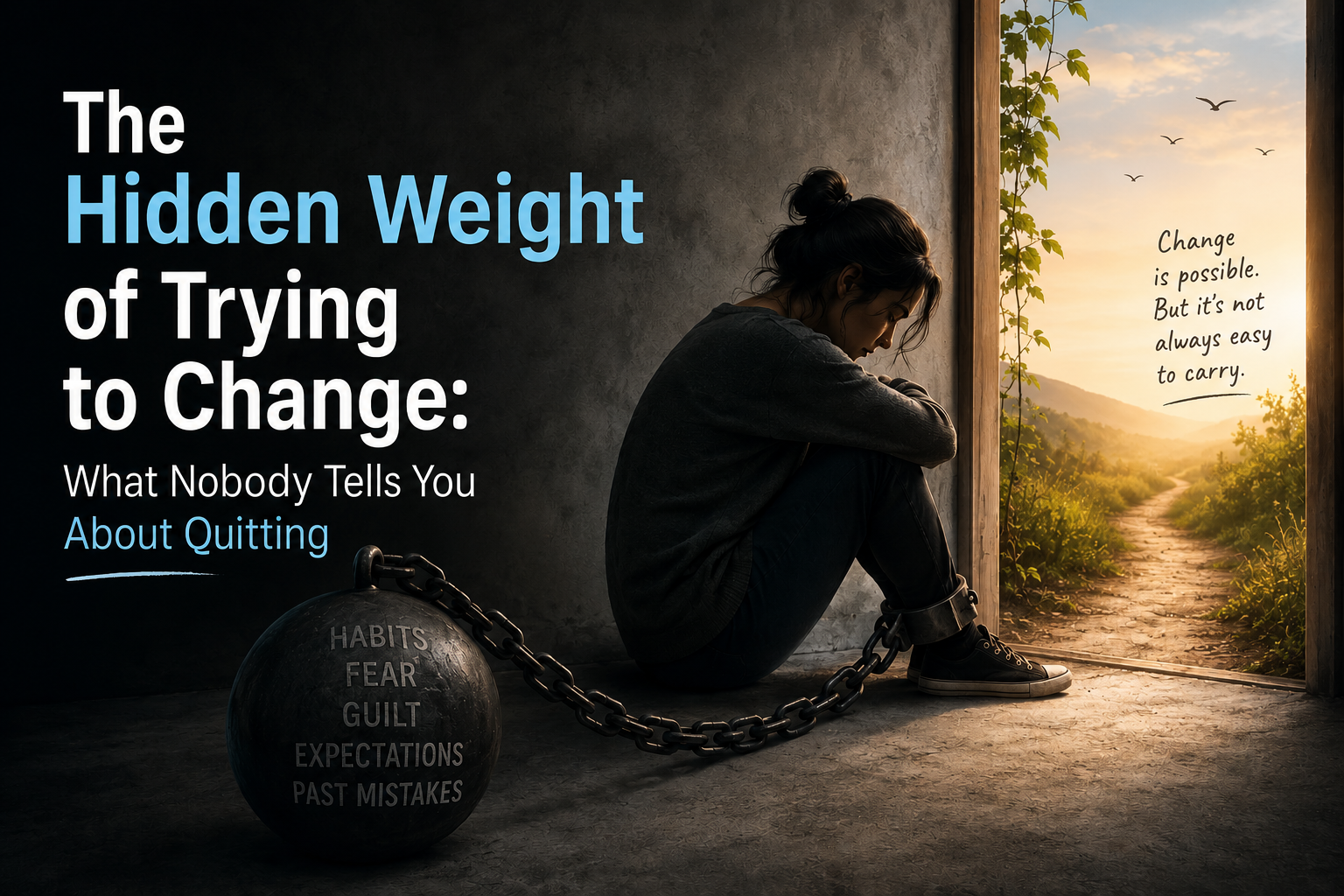
Behaviour change is almost never described accurately. In popular culture, public health messaging, and motivational advice, the arc is clean: a person decides to change, they struggle briefly, and then they succeed. The difficulty is acknowledged only enough to make the eventual victory feel meaningful. What is largely absent from this story is the granular, sustained, often invisible weight of what it actually costs a person to alter a habit that has been woven into the fabric of daily life.
For adult tobacco users considering change — whether through cessation, reduction, or switching to less harmful alternatives — this gap between the sanitised narrative and the lived reality creates a particular kind of suffering. When the actual experience feels nothing like the story, the most available interpretation is personal failure. And personal failure, as we have explored in previous articles, feeds shame, and shame feeds the habit the person was trying to leave behind.
This article is an attempt to describe the cost of change more honestly — not to discourage it, but to normalise it. Because understanding what change actually requires is the precondition for supporting it effectively.
The Neurochemistry of Withdrawal
The physical dimension of nicotine withdrawal is real and it is meaningful. Nicotine acts on acetylcholine receptors in the brain, and over time, the brain adjusts its baseline chemistry around the presence of nicotine. When nicotine is removed or significantly reduced, the brain's chemistry is temporarily out of balance. The resulting withdrawal profile varies by individual but commonly includes irritability, difficulty concentrating, increased appetite, disrupted sleep, and persistent craving.
These are not signs of weakness. They are predictable neurological events. The Diagnostic and Statistical Manual of Mental Disorders (DSM-5) classifies tobacco withdrawal as a recognised clinical syndrome, with symptoms beginning within 24 hours of stopping or significantly reducing use and typically peaking within the first week. Understanding this gives people something useful: a framework for interpreting what they are experiencing as biology, rather than as character flaw.
For many users, harm reduction tools — nicotine replacement therapies, heated tobacco products, or nicotine pouches — reduce the severity of this neurochemical disruption by maintaining nicotine delivery while removing combustion. This is not a compromise. It is a clinically informed reduction in friction that makes the first steps of change more survivable for a greater number of people.
The Social Dimension: Who You Are When You Don't Smoke
What is harder to describe, but equally significant, is the social identity disruption that accompanies behaviour change. For many adults, smoking is not simply something they do. It is something they have always done. It is part of how certain friendships were formed, certain rituals were shared, and certain parts of the day were structured. Changing the behaviour means, in some sense, renegotiating all of those things.
This is what psychologists describe as 'identity-based resistance.' The self-concept includes the behaviour, and removing the behaviour can feel like a loss of coherence rather than a gain in health. It is one reason that language matters so much in this conversation: a person who is told they 'are a smoker' faces a different psychological challenge than one who is told they 'have been using cigarettes.' The first requires them to become a different person. The second only requires them to change a behaviour.
A 2022 study published in the British Journal of Health Psychology found that identity-based interventions — those that invited participants to see themselves as 'someone who cares about health' rather than 'a smoker trying to quit' — produced significantly higher sustained behaviour change rates than information-only approaches. The shift in self-narrative, it turned out, was as important as the information about risk.
Relational Friction: When Change Disrupts the People Around You
There is also the friction that comes from the people around a person who is trying to change. This is rarely discussed in cessation literature, but in Pakistan's highly relational social culture, it is often decisive. A person who stops smoking at tea breaks may find that those breaks feel different, or that certain friendships become awkward. A person switching to a less visible alternative may face questions or skepticism from family members who do not understand what harm reduction means, or who interpret any ongoing nicotine use as failure.
In households where smoking is normalised, a family member trying to change is sometimes – unconsciously – resisted. Offers of cigarettes may continue. The social script of shared smoking remains active. This is not usually malice. It is the way social systems resist disruption, because any change in one person's behaviour changes the dynamics around them.
Understanding this does not mean accepting it as permanent. But it does mean that support for behaviour change should extend beyond the individual to include the conversations and environments around them. A person is far more likely to sustain change if the people closest to them have at least some understanding of what they are trying to do and why.
The Cost of Unrealistic Expectations
One of the most damaging things public health messaging has done in the tobacco space is to present change as simpler than it is. When campaigns frame cessation as a matter of decision and determination, they set up the majority of people to believe that their difficulty is exceptional. In fact, as decades of research confirm, difficulty is the norm. It is not the exception.
The result of this framing is a cycle in which attempts to change are followed by perceived failure, which produces shame, which reduces the likelihood of future attempts. A 2021 meta-analysis in Addiction covering fourteen countries found that ex-smokers reported an average of more than eight serious attempts before achieving sustained behaviour change. Each attempt carried a real emotional cost. And yet the framework offered to most people — try once, succeed, or you've failed — does not account for this at all.
A more honest narrative would tell people: this is hard, it takes multiple attempts for most people, and each step — including switching to a less harmful alternative — represents real progress. That narrative is not softer. It is truer. And truth is more useful than motivation.
Change is not a single act. It is an accumulation of attempts, adjustments, and small shifts — each of which has its own cost and its own value.
What was the cost of a change you made that mattered to you? We want to understand the real story, not the simplified one. Share below.