
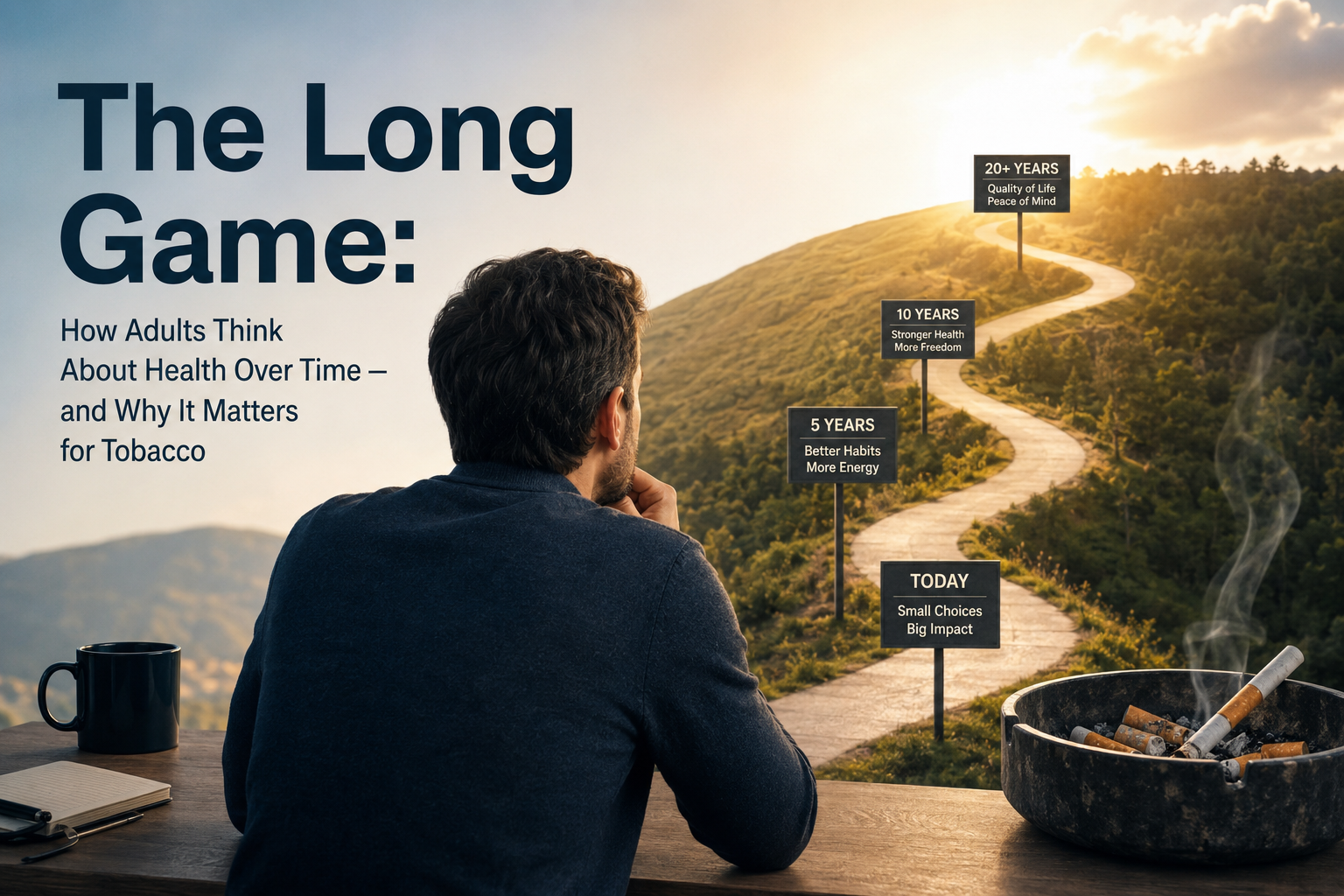
There is a well-documented asymmetry in the way human beings evaluate future consequences relative to present ones. Psychologists and behavioural economists call this temporal discounting — the tendency to assign significantly higher value to immediate outcomes than to outcomes that will unfold over time, even when the long-term outcomes are objectively larger. In the context of everyday decision-making, this is a feature, not a bug: prioritising the immediate allows rapid response to present circumstances. But in the context of health — where the consequences of today's behaviour compound, in either direction, over years and decades — temporal discounting has costs that are both significant and systematically underestimated.
In the context of tobacco, this asymmetry plays out with particular clarity. The immediate outcomes of smoking — relaxation, stress relief, social facilitation, habitual comfort — are experienced directly and vividly. The long-term health consequences — elevated cancer risk, cardiovascular deterioration, respiratory decline — are abstract, probabilistic, and removed in time. The same asymmetry applies, in reverse, to the benefits of harm reduction: the long-term gains from switching to a less harmful product are real and compounding, but they are deferred, intangible, and compete with the concrete costs and disruptions of change.
Understanding this asymmetry — and finding ways to make the long game legible and motivating rather than abstract and remote — is one of the most practically important challenges in tobacco harm reduction communication.
How Harm Accumulates — and How Reduction Compounds
Tobacco-related disease is predominantly a long-duration exposure story. Lung cancer, COPD, and tobacco-related cardiovascular disease are not typically the result of acute events. They are the result of years and decades of cumulative biological damage — damage that begins early in tobacco use and continues with each exposure. The body has considerable repair capacity, and in the early stages of tobacco use, that capacity can largely keep pace with the damage. But over time, the accumulated burden exceeds the repair capacity, and disease processes begin.
This trajectory has an important corollary: the earlier and more substantially a person reduces their exposure, the greater the compounding benefit over time. A body that is exposed to substantially fewer carcinogens and toxic compounds for twenty years accumulates substantially less biological damage than one that continues at the same exposure level. This is not merely a relative statement — it represents a meaningful difference in the probability of developing tobacco-related disease, and in the severity and timing of disease if it does develop.
The evidence on smoking cessation outcomes is instructive here. Analysis of the Framingham Heart Study and comparable longitudinal datasets consistently finds that the cardiovascular risk of ex-smokers begins to decline within months of cessation and continues declining over years. Within five to ten years of cessation, cardiovascular risk approaches that of never-smokers for many individuals. Respiratory function recovers partially and progressively. The timeline of recovery is real and measurable — and it applies, proportionately, to harm reduction too. A switch to a substantially less harmful product initiates a similar, if less dramatic, trajectory of reduced exposure and biological recovery.
Making the Long Game Legible
The practical challenge for harm reduction communication is making this trajectory visible and motivating in the context of daily life, where immediate experience consistently competes with long-term projection. Several approaches have shown meaningful effectiveness in behavioural research.
Future self-continuity: Research by psychologist Hal Hershfield has shown that people who have a stronger psychological connection to their future self — who experience their future self as genuinely continuous with who they are now, rather than as an abstract stranger — make significantly better long-term decisions. This finding has been applied in financial planning, retirement saving, and, more recently, in health behaviour research. In the context of tobacco harm reduction, communications that invite adults to consider the health of their future self — not as an abstraction, but as a continuation of their present self — can partially offset the effects of temporal discounting.
Progress framing: There is strong evidence that framing behaviour change in terms of progress rather than perfection improves sustained engagement. An adult who understands that each day of reduced exposure is a quantifiable biological gain — not merely an absence of the 'bad' behaviour — has a motivational framework that can sustain action through difficulty. The vocabulary of investment is useful here: harm reduction is not a compromise; it is a deposit into a long-term health account that compounds over time.
Concrete milestones: Abstract long-term projections are less motivating than concrete near-term indicators. Where possible, harm reduction communications should include tangible, near-term markers of biological recovery — reduced breathlessness within weeks, improved circulation within months, declining cancer risk tracked in years — that make the long-term trajectory feel present and accessible.
The Long Game in Pakistan's Health Context
Pakistan's current disease burden makes the long game in tobacco particularly consequential. Tobacco-related illnesses represent a significant proportion of non-communicable disease burden in the country, and the health infrastructure for managing late-stage tobacco-related disease is significantly overstretched. The long-game logic of harm reduction — preventing disease decades from now by reducing exposure today — has implications not only for individual health but for the collective capacity of Pakistan's health system.
Adults who understand this relationship — who see their individual health choices not just as personal but as situated within a larger social reality — have, on average, stronger long-term motivation than those operating purely from individual self-interest. Building that understanding, without moralising or creating pressure, is part of the role this platform aims to play.
Every day of reduced harm has a compounding return. Not as a slogan — but as a biological and statistical fact. Understanding that changes what even small steps feel like.
What would you want your future self to know about a health choice you are making today? Share below — it might be one of the most useful things someone reads this week.