
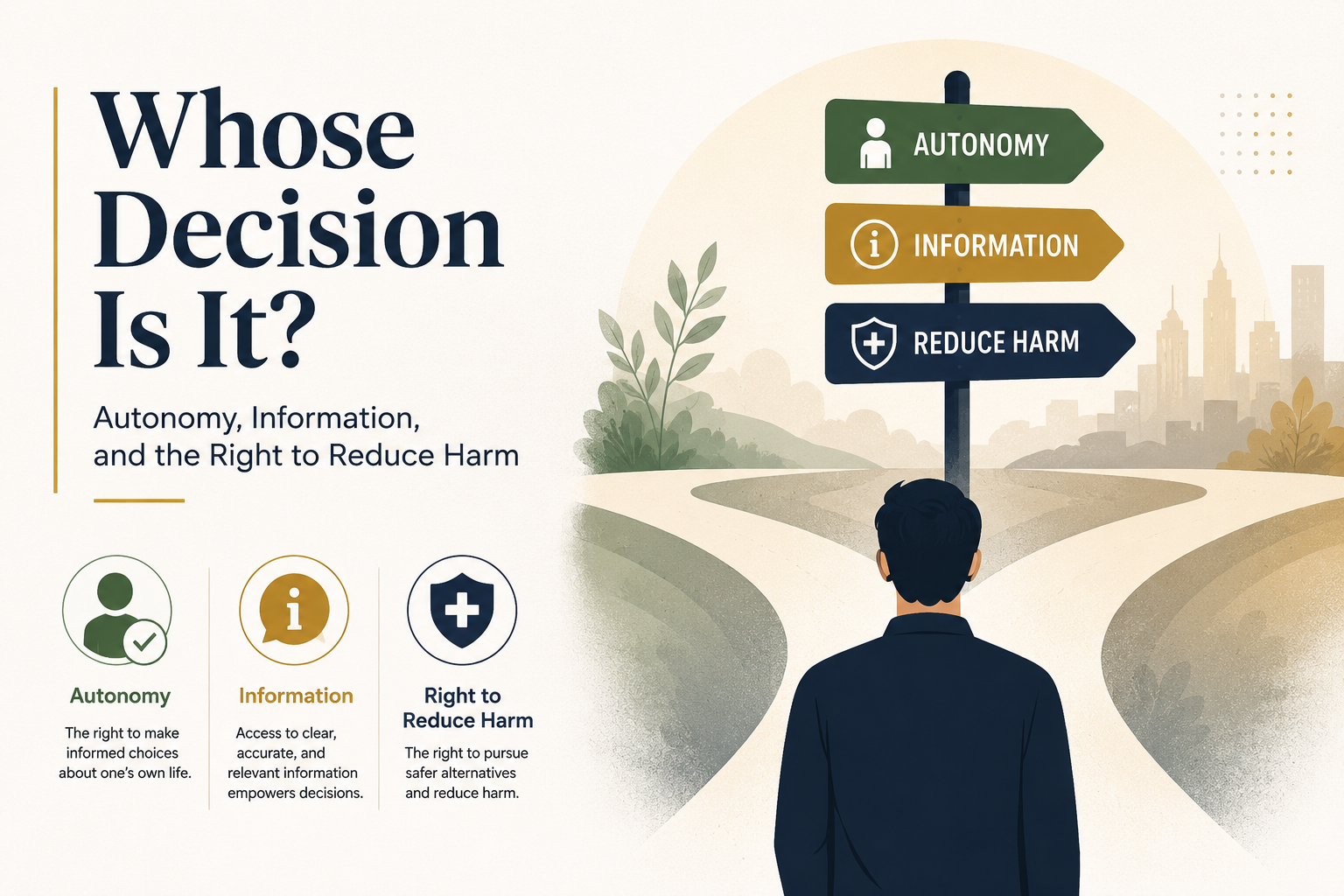
There is a principle at the centre of modern medical ethics that receives less attention in public health messaging than it deserves: the principle of autonomy — the idea that competent adults have the right to make decisions about their own bodies and health, provided those decisions are informed. In clinical medicine, autonomy is treated as close to sacred. A patient cannot be forced into a treatment, however clearly beneficial a physician believes it to be. Consent must be free, and it must be informed.
In tobacco control, this principle is applied selectively. Adults who smoke are frequently addressed not as decision-makers entitled to complete information, but as problems to be corrected — through warnings, restrictions, and messaging designed to produce a single outcome: cessation. There is nothing wrong with encouraging cessation. It remains the single best outcome for health. But there is something incomplete about a framework that treats the adult smoker primarily as a target of behaviour change rather than as a person capable of weighing risk, benefit, and personal circumstance, provided the relevant information is actually made available.
Paternalism and Its Limits
Public health has a long, complicated relationship with paternalism — the practice of restricting or shaping people's choices for their own presumed good. Some paternalism is justified and largely uncontroversial: seatbelt laws, food safety standards, restrictions on selling tobacco to minors. But paternalism has limits, and those limits are typically drawn at the point where an intervention stops informing adult decision-making and starts substituting for it.
Tobacco harm reduction sits directly on this line. An adult who currently smokes and is not able or willing to quit entirely retains, under any reasonable ethical framework, the right to know that non-combustible alternatives exist, and the right to know what the evidence says about their comparative risk. Withholding that information, or presenting it in a deliberately confusing way, is not neutral. It is a form of paternalism that denies adults the basic materials of informed choice — while claiming, often sincerely, to be protecting them.
What Informed Consent Looks Like in Practice
Informed consent, as a concept, requires three things: capacity, information, and voluntariness. Capacity is rarely in question for adult tobacco users. Voluntariness is a separate conversation, tied up with addiction and dependence, and deserving of its own nuanced treatment rather than a simple assertion that nicotine dependence eliminates the possibility of meaningful choice. But information — the second requirement — is where the current landscape falls consistently short.
An adult cannot exercise genuine autonomy over a decision they do not have accurate information to make. If the available information about tobacco alternatives is fragmented, contradictory, or absent, autonomy becomes a formality rather than a reality. This is why access to accurate, comparative information about tobacco and nicotine products is not simply a public health nicety. It is a precondition for the kind of decision-making that respect for persons requires.
What This Means in Pakistan's Context
In Pakistan, where health literacy varies enormously by geography and income, and where information about tobacco alternatives is unevenly distributed, respecting autonomy requires active work — not simply the absence of coercion. It requires building the information infrastructure that makes real choice possible: accessible language, credible sourcing, and a willingness to trust adults with complete information rather than a curated, simplified version designed to produce a particular outcome.
This does not mean abandoning a preference for cessation. It means being honest about what respecting autonomy actually requires: giving adults the same standard of information they would expect from a physician discussing any other medical decision, and trusting them to weigh it.
Respecting a person's autonomy does not mean staying silent about what is best. It means making sure they have what they need to decide for themselves — and then respecting the decision they make.
What would change about how you think of tobacco and nicotine decisions if they were treated with the same standard of informed consent as any other medical choice? Tell us below.