
Ask most people what 'being active' means, and the answer usually involves a gym, a structured workout, or a block of dedicated exercise time. This framing, while not wrong, has an unintended side effect: it makes physical activity feel like an all-or-nothing proposition, gated behind time, money, and motivation that many people simply don't have on a given day. The research on physical activity and health tells a more forgiving story — one in which the movement that accumulates across an ordinary day matters more than most people assume, and matters almost independently of whether a formal workout happens at all.
What NEAT Actually Is
Physiologists use a term — non-exercise activity thermogenesis, or NEAT — to describe the energy expended through all the movement that isn't formal exercise: walking to get somewhere, standing rather than sitting, taking the stairs, fidgeting, doing household tasks. For most people, NEAT accounts for a larger share of daily energy expenditure than structured exercise does, simply because it happens continuously across sixteen or more waking hours, while a workout — even a rigorous one — occupies a fraction of that time.
More importantly, NEAT has consequences beyond calories. Research consistently links higher levels of incidental daily movement to better cardiovascular markers, improved insulin sensitivity, and lower all-cause mortality risk — independent of whether a person also exercises formally. This does not mean structured exercise is unimportant. It means the absence of a gym habit is not the health catastrophe it is often made out to be, provided the rest of the day isn't spent entirely sedentary.
The Cost of Modern Sedentary Design
Pakistan's urban environments, like most rapidly growing cities, have been built in ways that quietly suppress incidental movement. Long commutes in private transport, desk-based work, home delivery for nearly everything, and limited walkable infrastructure combine to produce days that can pass with remarkably little movement — even for people who consider themselves reasonably healthy. The problem isn't laziness. It is a built environment that has engineered movement out of daily life by default.
This matters because the health risks of prolonged sitting are now well documented and appear to operate somewhat independently of exercise habits. Multiple large studies have found that people who sit for most of the day face elevated cardiovascular and metabolic risk even when they exercise regularly — a pattern sometimes described as being an 'active couch potato': fit during the workout, sedentary for the other twenty-three hours.
What Actually Moves the Needle
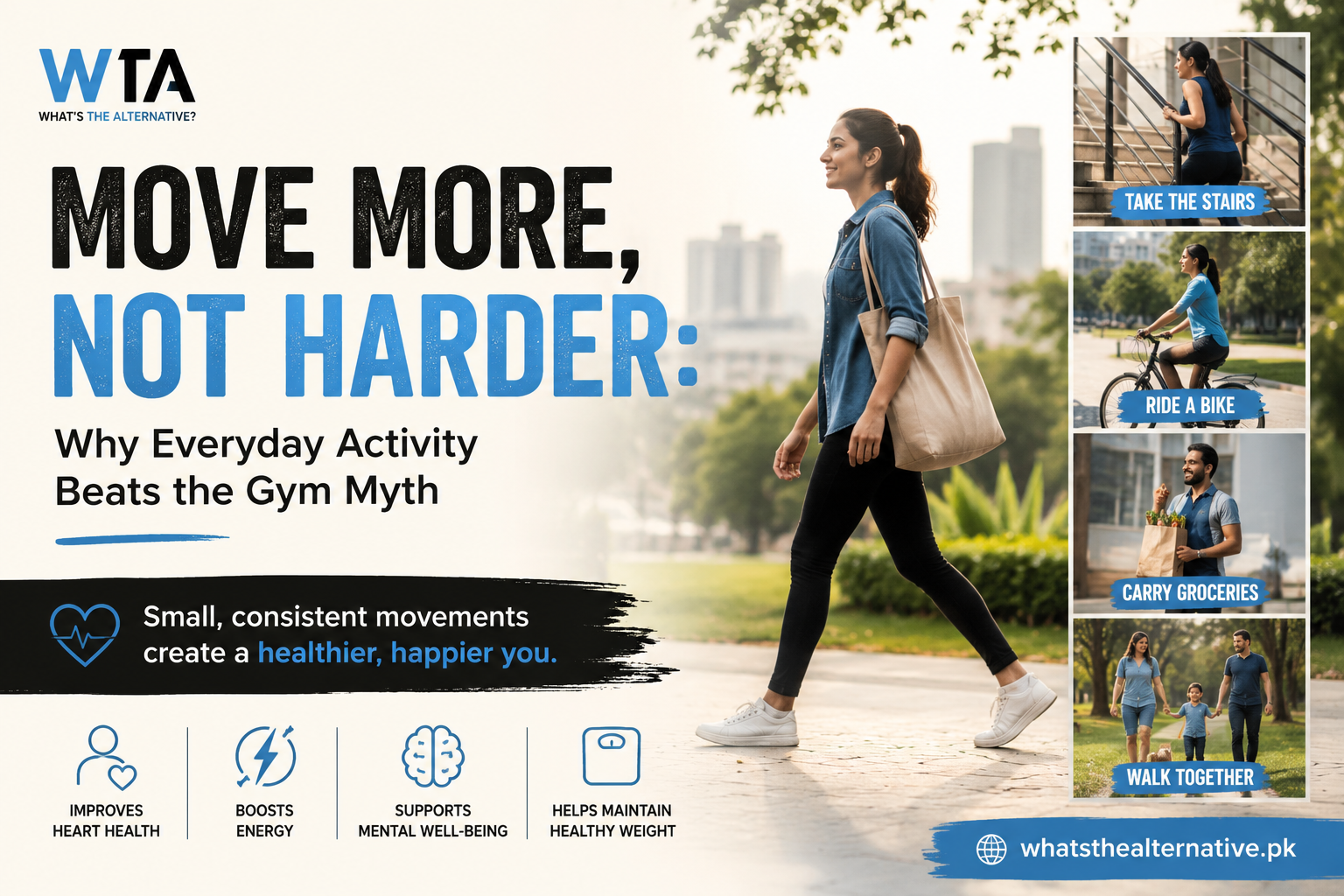
The practical implication is not that structured exercise is unnecessary — it remains valuable, particularly for strength and cardiovascular capacity that incidental movement doesn't fully replicate. The implication is that the gap between 'no exercise routine' and 'meaningfully more active' is smaller and more accessible than it appears. Taking stairs instead of elevators, standing during phone calls, parking further away, walking for short errands instead of driving, and simply interrupting long sitting blocks every hour all measurably shift the daily activity total — without requiring a gym membership, special clothing, or a block of free time that many people don't have.
For someone who has tried and abandoned formal exercise routines multiple times, this reframe can be genuinely useful: the goal is not to become a different kind of person who goes to the gym. The goal is to notice and slightly increase the movement that is already woven through an ordinary day.
The healthiest amount of movement is rarely the most dramatic amount. It is the amount that survives contact with an ordinary week — which usually means the movement that doesn't require a special occasion to happen.
What's one point in your day where you could realistically move a little more — not dramatically, just a little? Share below.