
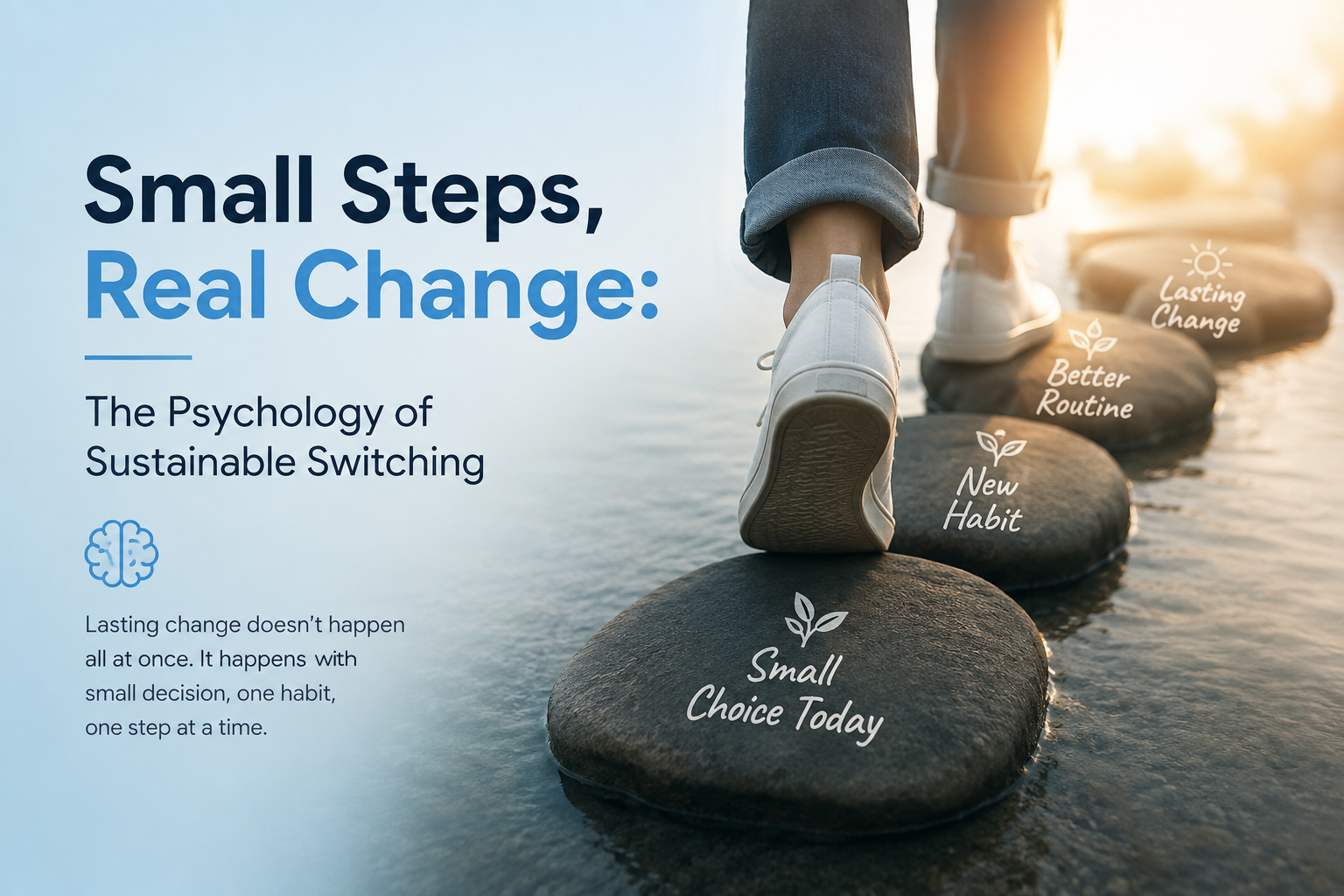
Behaviour change is often imagined as a single decisive moment — the day someone quits, switches, or starts. In reality, the science of habit formation tells a less dramatic and more useful story: sustainable change is rarely a single decision. It is a sequence of small, repeated actions that gradually reshape automatic behaviour, supported by an environment that makes the new behaviour easier than the old one.
The Cue-Routine-Reward Loop
Habits, including tobacco use, operate through a well-documented psychological loop: a cue triggers a routine, which delivers a reward, which reinforces the loop over time until it requires little conscious thought. A cigarette after a meal, during a stressful call, or with morning coffee is rarely a deliberate decision by the thousandth repetition — it is an automatic response to a familiar cue.
This has a direct implication for switching to a less harmful alternative: the goal is not simply to substitute one product for another in the abstract. It is to interrupt the specific cue-routine-reward loop and rebuild it around the new behaviour, cue by cue. Switching 'in general' is a weak strategy. Switching at the specific moments where the old habit is triggered — the after-meal cue, the stress-call cue — is a strategy grounded in how habits actually function.
Why All-or-Nothing Framing Backfires
Public health messaging has a tendency to frame behaviour change in binary terms: someone either quits or they haven't succeeded. This framing, while well-intentioned, works against how sustainable change actually happens. Research on habit change consistently finds that gradual, staged approaches — reducing frequency in specific contexts, switching in some situations before others, allowing for inconsistency along the way — produce more durable change than an all-or-nothing standard that treats any lapse as total failure.
For someone attempting to reduce tobacco-related harm, an all-or-nothing standard can be actively counterproductive: a single lapse, framed as failure, often triggers a full return to the old behaviour, because the psychological cost of 'starting over' feels higher than the cost of simply continuing. A framework that treats partial, inconsistent progress as real progress — rather than as failure — keeps people engaged with the change rather than abandoning it after the first setback.
“In clinical practice, we often care for patients who have tried repeatedly to quit smoking without success. While complete cessation remains the ideal outcome, we should also have informed conversations about evidence-based harm reduction options for adults who would otherwise continue to smoke. Our responsibility is to help patients make better choices based on science.”
Dr. Zafar Iqbal Chaudhry – Physician
Designing the Environment, Not Just the Intention
The most consistent finding in habit-change research is that environment design outperforms intention. Making the new behaviour physically easier and more visible than the old one — keeping the alternative product accessible in the exact locations where the old cue occurs, removing the old product from those same locations — shifts the path of least resistance, which is what habits actually follow, largely independent of willpower.
What This Looks Like in Practice
For someone switching away from combustible cigarettes, this suggests a specific, practical approach: identify the two or three most frequent cues (after meals, during work breaks, in social settings), address them one at a time rather than attempting a complete overhaul at once, keep the alternative visibly accessible at exactly those moments, and treat any lapse as information rather than failure — a signal about which cue needs more support, not a verdict on the whole effort.
Sustainable change is built cue by cue, not through a single act of willpower. Understanding that isn't a lower standard — it's a more accurate one, and a more forgiving one, for anyone in the middle of trying.
Which specific moment in your day is hardest to change — and what would make the alternative easier to reach for, right at that moment? Share below.