
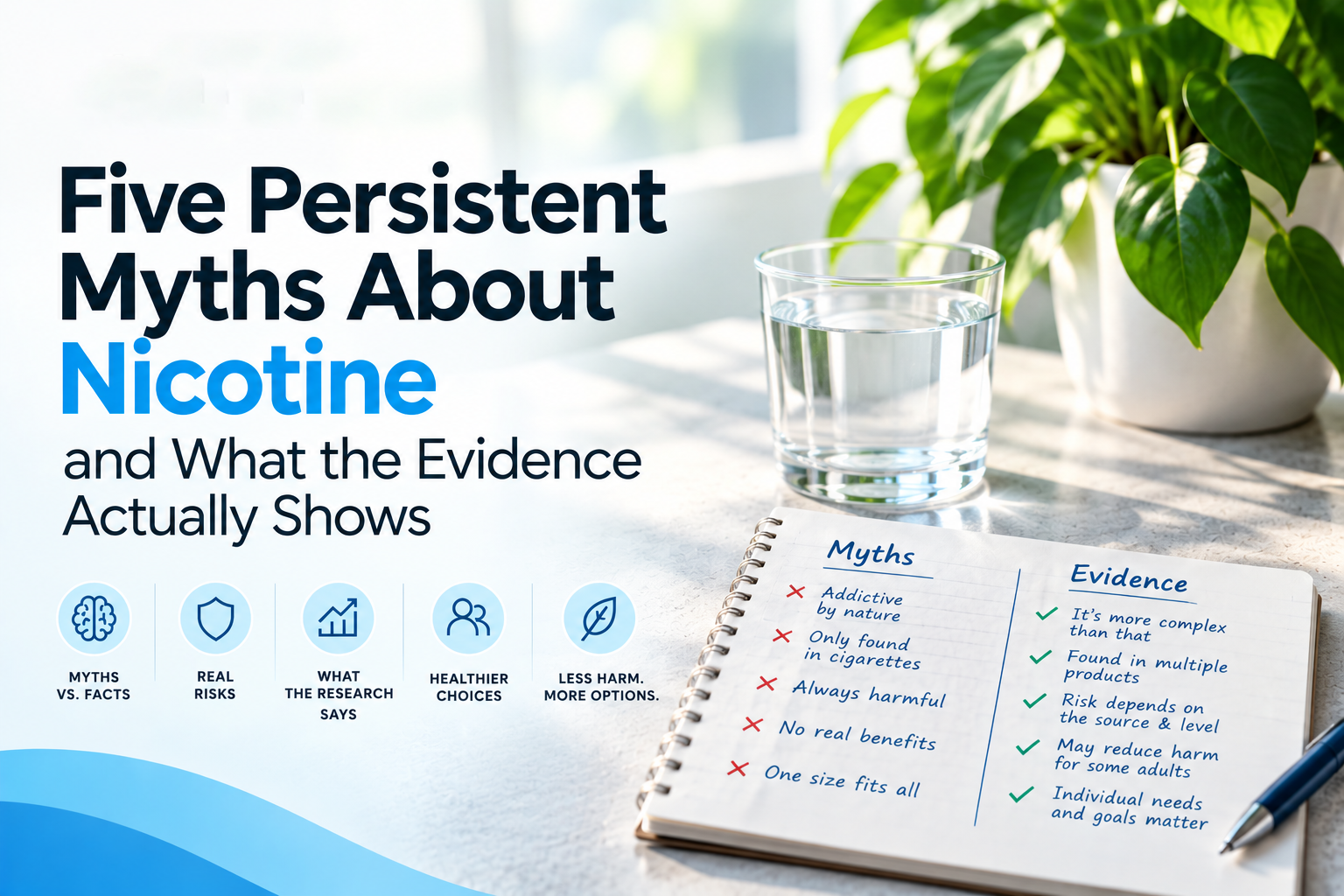
Few substances are as consistently misunderstood as nicotine. Decades of tobacco control messaging, much of it well-intentioned, has often blurred the distinction between nicotine itself and the combustion process that delivers it in a cigarette — with the practical effect that many adults carry beliefs about nicotine that the evidence does not support. Correcting these beliefs is not about minimising risk. It is about making sure the risk that does exist is understood accurately, rather than exaggerated in ways that obscure genuinely useful distinctions.
Myth One: Nicotine Is the Primary Cause of Smoking-Related Cancer
This is, by a wide margin, the most consequential misconception in tobacco harm reduction. Cancer risk from smoking is driven overwhelmingly by the thousands of chemical compounds produced during combustion — not by nicotine, which is not classified as a carcinogen by major health authorities. Nicotine sustains dependence and has cardiovascular effects worth taking seriously, but conflating it with the carcinogenic burden of cigarette smoke leads directly to the incorrect conclusion that all nicotine-containing products carry equivalent cancer risk to smoking.
Myth Two: Nicotine Replacement Therapy Just Substitutes One Addiction for Another
NRT products deliver controlled, pharmaceutical-grade nicotine without any of the thousands of combustion byproducts found in cigarette smoke. Decades of research and regulatory approval support their safety profile for both cessation and longer-term harm reduction use. Describing NRT use as 'just another addiction' equivalent to smoking ignores the enormous difference in health risk between nicotine alone and nicotine delivered through burning tobacco.
Myth Three: If a Product Contains Nicotine, It Must Be Roughly as Harmful as a Cigarette
This belief treats nicotine content as a proxy for overall harm, when the evidence consistently points to combustion — not nicotine presence — as the dominant driver of tobacco-related disease. Heated tobacco products, e-cigarettes, pouches, and NRT all contain nicotine and differ enormously from cigarettes and from each other in their broader risk profile, largely based on whether and how combustion occurs.
Myth Four: Once Someone Reduces Their Smoking, the Damage Is Already Done, So Switching Doesn't Matter
This is both inaccurate and, in a subtle way, counterproductive — since believing it can discourage someone from making a change that would genuinely help. Cardiovascular risk begins declining within months of reducing exposure to combustion products, and the body's repair capacity continues functioning meaningfully even after years of smoking. The benefit of switching is real at nearly any stage, even if it is not the same as never having smoked.
Myth Five: 'Natural' or 'Herbal' Alternatives Are Automatically Safer Because They Avoid Synthetic Nicotine
Combustion is the primary hazard in tobacco products, not the synthetic-versus-natural status of the nicotine itself. A herbal product that is still burned and inhaled carries the same fundamental combustion-related risk as a cigarette, regardless of how it is marketed. 'Natural' is a marketing category, not a risk category.
Why These Corrections Matter
None of these corrections argue that nicotine is risk-free — it isn't, and dependence itself carries real costs worth taking seriously. But accuracy matters. An adult who believes nicotine alone causes cancer has no reason to consider a nicotine-containing alternative to cigarettes as meaningfully different from smoking. Correcting that single belief can open up a category of options that person may never have otherwise considered.
Getting the details right is not a technicality. For an adult trying to make a genuinely informed decision, the difference between an accurate belief and an inaccurate one about nicotine can be the difference between considering an alternative and dismissing it outright.
Which of these five, if any, matched something you used to believe? Share below — it helps us understand where the information gap is widest.