
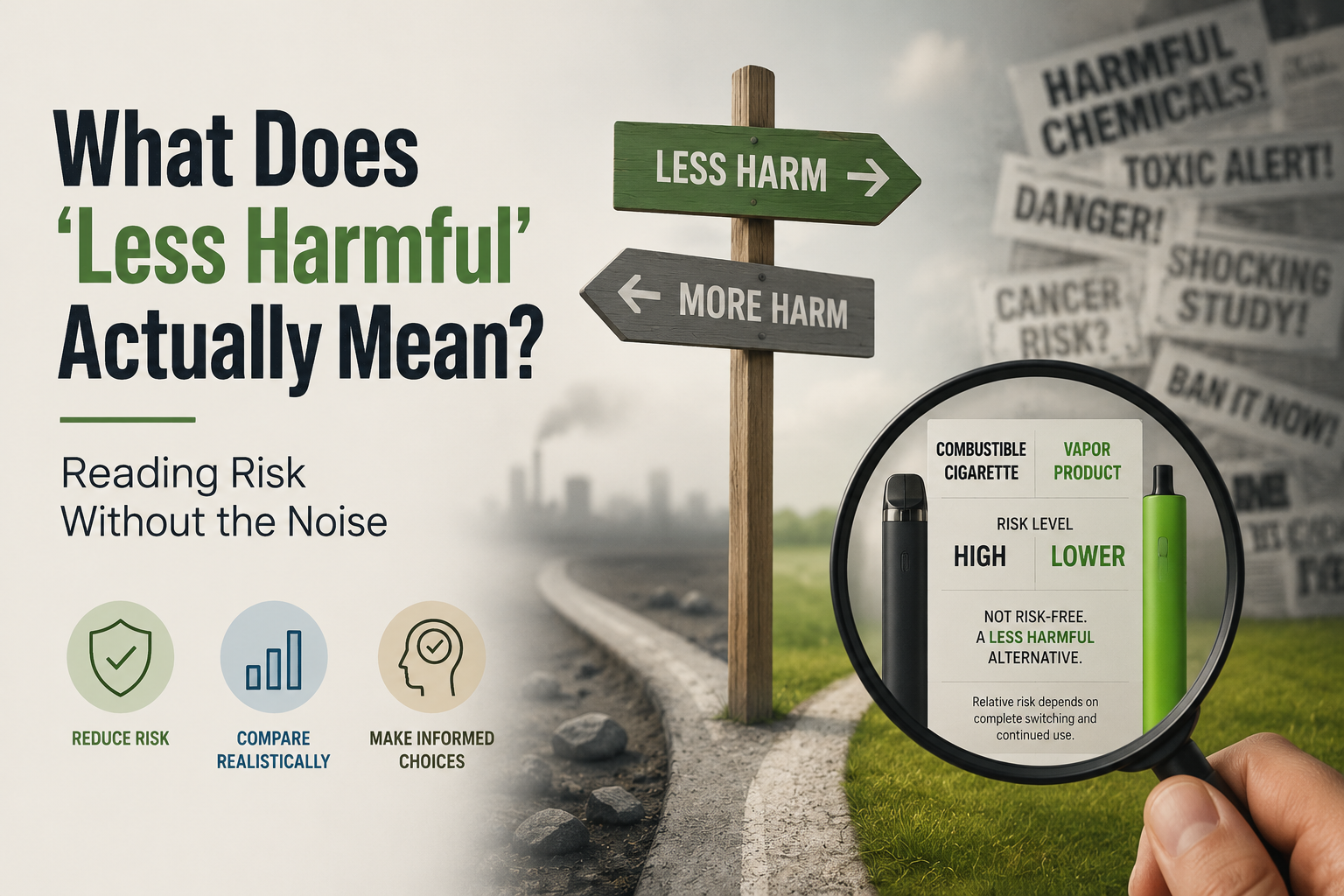
In an era defined by the rapid circulation of information, distinguishing between accurate risk communication and noise has become one of the most practically important skills an adult can develop. Nowhere is this more evident than in conversations about tobacco and nicotine, where the public sphere is saturated with messages that range from carefully evidenced to wildly misleading — and where the stakes of misunderstanding are, in the most literal sense, a matter of health and life.
The question this article examines is deceptively simple: when a product or behaviour is described as 'less harmful,' what does that actually mean? What evidence sits behind that claim? By what standard is the comparison being made? And how can an ordinary adult — without a background in toxicology or epidemiology — evaluate that kind of statement with enough rigour to make genuinely informed decisions?
These are not abstract questions. For the millions of adults in Pakistan and around the world who currently use tobacco, and who are trying to navigate a confusing landscape of products, claims, and counter-claims, the ability to read risk more accurately could make a material difference to the choices they are able to make.
Risk Is Not Binary
The first and most important thing to understand about risk is that it is not binary. Most public health communication — and especially most tobacco-related public health communication — implicitly treats risk as an on/off question: something is either dangerous or it isn't. This framing is emotionally satisfying because it provides clarity. It is intellectually dishonest because it does not correspond to how risk actually works.
In reality, almost all health-relevant behaviours and products exist on a spectrum of risk. The relevant questions are not 'is this risky or not?' but rather: How risky, compared to what? In what quantities, over what timeframe? For which population? Under what conditions of exposure? Compared to which available alternatives?
When a product is described as 'less harmful' than cigarettes, that claim should be understood within this framework. It is a comparative, evidence-based statement, not a marketing assertion. The comparison being made is to combustible cigarettes, which are among the most reliably documented causes of preventable premature death in the human history of product development. That baseline matters enormously when evaluating the relative risk of any alternative.
What the Evidence Base Actually Says
Across several categories of non-combustible nicotine products — including nicotine replacement therapies, e-cigarettes, heated tobacco products, and oral nicotine products — the accumulated evidence base points consistently in the same direction: elimination of combustion substantially reduces exposure to the most harmful constituents of tobacco smoke.
The mechanism is straightforward. The major disease burden associated with tobacco use — lung cancer, COPD, cardiovascular disease — is driven primarily by the chemical composition of tobacco smoke as it enters the lungs. That smoke is produced by the combustion process: burning tobacco at temperatures that generate thousands of chemical compounds, dozens of which are known carcinogens. Products that deliver nicotine without combustion — whether by heating rather than burning, or by oral absorption — dramatically reduce or eliminate the exposure that drives this disease burden.
This does not mean non-combustible products are without risk. Nicotine itself carries risks, primarily related to dependence and cardiovascular effects at high doses. Some non-combustible products have their own associated hazards. Long-term population-level data on newer products continues to be gathered. But the relevant comparison for an adult who currently smokes cigarettes is not between a non-combustible product and a perfectly risk-free alternative. The relevant comparison is between that product and continued combustible cigarette use. And on that comparison, the direction of the evidence is clear.
Public Health England's repeated evidence reviews conclude that vaping is substantially less harmful than smoking. The Cochrane Collaboration — the gold standard for systematic evidence review in medicine — has assessed the evidence for harm reduction from nicotine e-cigarettes and found meaningful reductions in harmful constituent exposure compared to smoking. Researchers studying Swedish snus use have documented cancer and cardiovascular mortality rates among Swedish men that are substantially lower than in comparable European populations with higher smoking rates. These findings are not cherry-picked. They represent the current scientific consensus as it exists.
How Misinformation Circulates and What to Watch For
Understanding why the evidence is not more widely known requires looking at how information about tobacco and nicotine travels through public discourse. Several identifiable patterns account for much of the confusion.
The first is equivalence framing — the rhetorical move of treating all nicotine-containing products as equally dangerous because they all carry some risk. This appears in news coverage, in public campaigns, and in social media content. It is rarely based on a careful comparative analysis. It is based on the implicit assumption that because all nicotine products involve some exposure, they are interchangeable from a health perspective. This assumption is not supported by the evidence.
The second is precautionary overclaiming — citing uncertainty about the long-term effects of newer products as a reason to treat them as equivalent to combustible cigarettes in terms of risk. Genuine uncertainty about long-term outcomes is scientifically legitimate and worth acknowledging. But uncertainty about whether a non-combustible product carries 2% of the disease risk of cigarettes or 5% of the disease risk does not make it equivalent to cigarettes. Uncertainty operates within a range, and that range matters.
The third is selective citation — using individual studies that show concerning findings about specific products, in specific conditions, with specific populations, as if they represent the overall evidence base. Good evidence evaluation requires looking at the breadth and quality of the available research, not the most alarming individual data point.
What Informed Consumer Awareness Looks Like
For an adult trying to navigate these questions, a handful of practical frameworks can help.
First: look for the comparison. When a claim is made about a product's risk, ask what it is being compared to. A statement that a product 'may cause harm' tells you almost nothing without knowing what alternative it is being compared to. All relevant risk claims should be evaluated relative to available alternatives.
Second: check the source's methodology. Is the claim based on laboratory studies of exposure levels? On epidemiological data? On self-reported outcomes? Each type of evidence has strengths and limitations. Broadly based systematic reviews — which analyse multiple studies across multiple methodologies — are generally more reliable than single studies or expert opinion.
Third: be cautious of absolutism in either direction. A product described as completely harmless and a product described as just as dangerous as cigarettes are both making extraordinary claims that require extraordinary evidence. The truth about most non-combustible nicotine products sits somewhere in between: meaningfully less harmful than cigarettes, with risks that are real but substantially lower.
Fourth: recognise that the goal of informed consumer awareness is not certainty. The goal is proportionate understanding — the ability to make decisions that reflect the actual risk landscape, rather than a distorted version of it constructed by commercial interest, moral panic, or inadequate information.
Adults deserve access to accurate, evidence-based risk information. That is not a radical claim. It is the minimum required for genuine informed choice. And genuine informed choice, consistently applied, is one of the most powerful tools available for improving population health outcomes.
What would you want to know about a less harmful alternative before considering it? Tell us below — your questions help us shape what we cover next.