
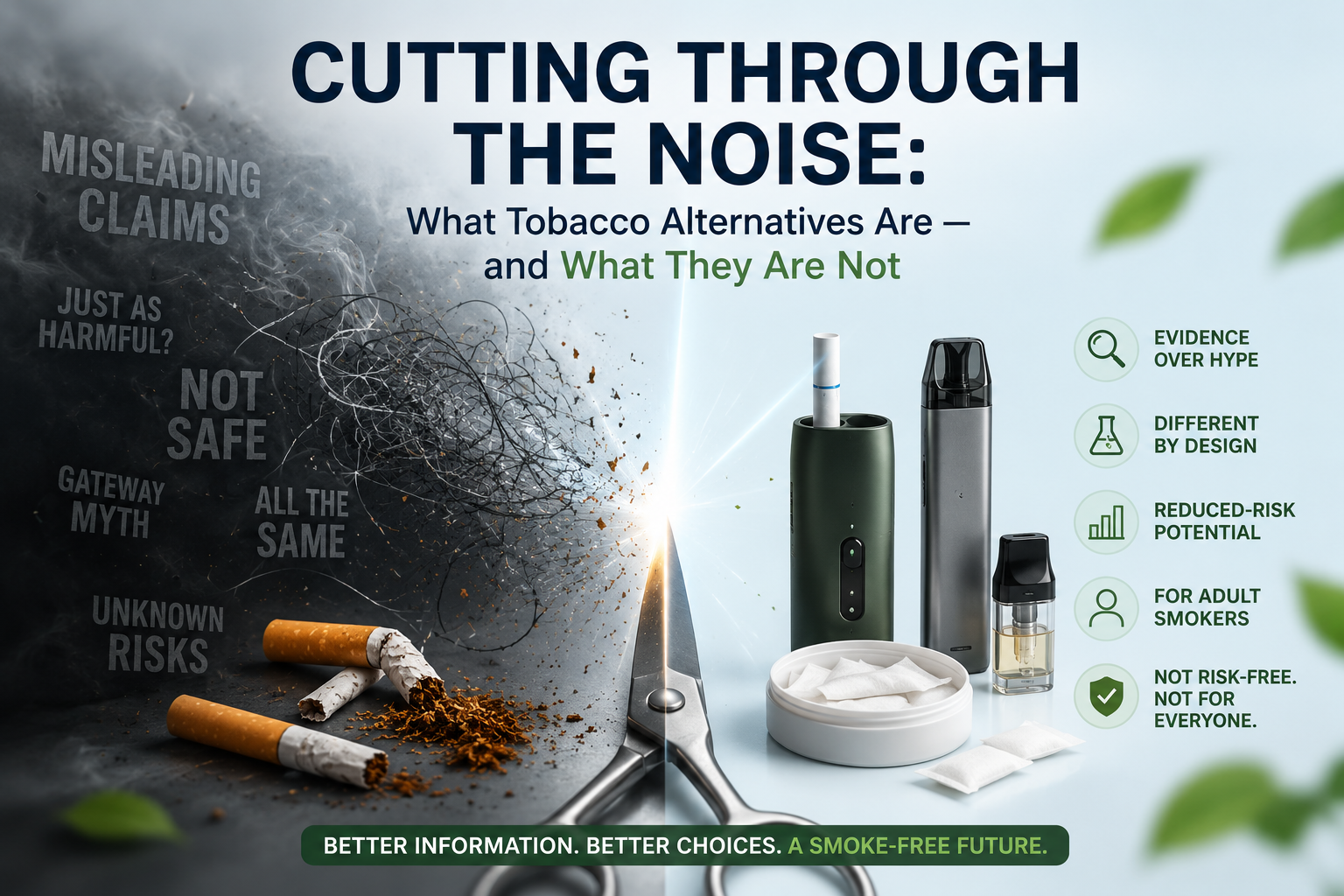
There is a category of harm that public health campaigns rarely account for: the harm caused by bad information. In the context of tobacco and nicotine, a specific and consequential version of this harm plays out continuously. Adults who currently smoke — and who might benefit from accurate knowledge about less harmful alternatives — are routinely exposed to information that obscures rather than clarifies the relevant distinctions. The result is not caution. The result is confusion. And confusion, in matters of health, tends to produce inertia, which means continuation of the most harmful available behaviour.
This article is an attempt to describe, plainly and accurately, what the main categories of tobacco alternatives actually are — how they work, what distinguishes them from combustible cigarettes, and what the available evidence says about their comparative risk profile. It is not a promotional document for any category of product. It is an attempt to provide the kind of clear, comparative information that should be available to all adults making decisions about tobacco and nicotine.
What Combustion Does — and Why It Matters
To understand why some alternatives are considered less harmful than cigarettes, it is necessary to understand what cigarette smoke actually is and why it is harmful. When tobacco burns, it undergoes combustion at temperatures exceeding 800 degrees Celsius. This process generates a chemical cocktail of more than seven thousand compounds. Of these, at least 70 are known carcinogens — including formaldehyde, benzene, polonium-210, and arsenic. The disease burden associated with smoking — lung cancer, oral cancer, COPD, cardiovascular disease, stroke — is driven predominantly by this chemical exposure, delivered with every inhalation, over years and decades.
Nicotine, the addictive component of tobacco, is not the primary driver of this disease burden. It contributes to cardiovascular risk, particularly at high doses, and it sustains dependence. But the mortality and morbidity that make smoking the leading cause of preventable death worldwide are primarily attributable to the products of combustion — not to nicotine per se. This distinction is not a technicality. It is the entire basis on which harm reduction logic rests.
The Main Categories of Alternatives — What They Are
E-cigarettes and Vaping Devices: These devices heat a nicotine-containing liquid to produce an aerosol. There is no combustion involved. The aerosol contains nicotine and a small number of other compounds — some of which carry risk — but it does not contain the thousands of combustion-derived compounds found in cigarette smoke. Public Health England's evidence reviews, updated through the mid-2020s, have consistently estimated that vaping is substantially less harmful than smoking, though the estimates carry uncertainty and long-term population-level data continues to accumulate.
Heated Tobacco Products (HTPs): These devices heat processed tobacco to temperatures well below combustion — typically between 250 and 350 degrees Celsius. Because combustion does not occur, the toxic combustion compounds are either absent or present in dramatically reduced quantities compared to cigarette smoke. Multiple independent analyses, including assessments by the US FDA's Tobacco Products Scientific Advisory Committee, have confirmed that HTPs produce substantially lower levels of the most harmful and potentially harmful compounds identified in cigarette smoke.
Oral Nicotine Products: This category includes nicotine pouches and snus (moist tobacco pouches used orally). These products involve no inhalation and no combustion. In countries with long histories of snus use — notably Sweden and Norway — epidemiological data has documented substantially lower rates of tobacco-related cancer and cardiovascular mortality compared to countries with comparable tobacco use but higher smoking rates. This data is the most mature long-term population-level evidence available for any tobacco harm reduction category.
What the Evidence Base Is and Is Not Saying
The scientific consensus across these categories points in a consistent direction: removing combustion substantially reduces exposure to the compounds most responsible for tobacco-related disease. That is a meaningful statement. It does not mean any of these alternatives is risk-free. It does not mean they are appropriate for non-tobacco users. It does not mean nicotine dependence is unimportant. But for an adult who currently smokes and is not ready or able to achieve complete cessation, access to accurate comparative information about these products is essential.
In Pakistan, where combustible cigarette use remains widespread and public health infrastructure for cessation support is limited, the stakes of this information gap are significant. Adults who might make different choices with different information are, in many cases, not making those choices — not because they do not want to, but because the information available to them has not made those choices visible and legible.
That is the problem this platform exists to address. Not to advocate for any specific product or category. But to ensure that the decision adults make about tobacco and nicotine is, at minimum, a genuinely informed one.
The opposite of a bad health decision is usually not a perfect health decision. It is a better-informed one.
What was the first accurate piece of information you received about tobacco alternatives — and where did it come from? Tell us below.