
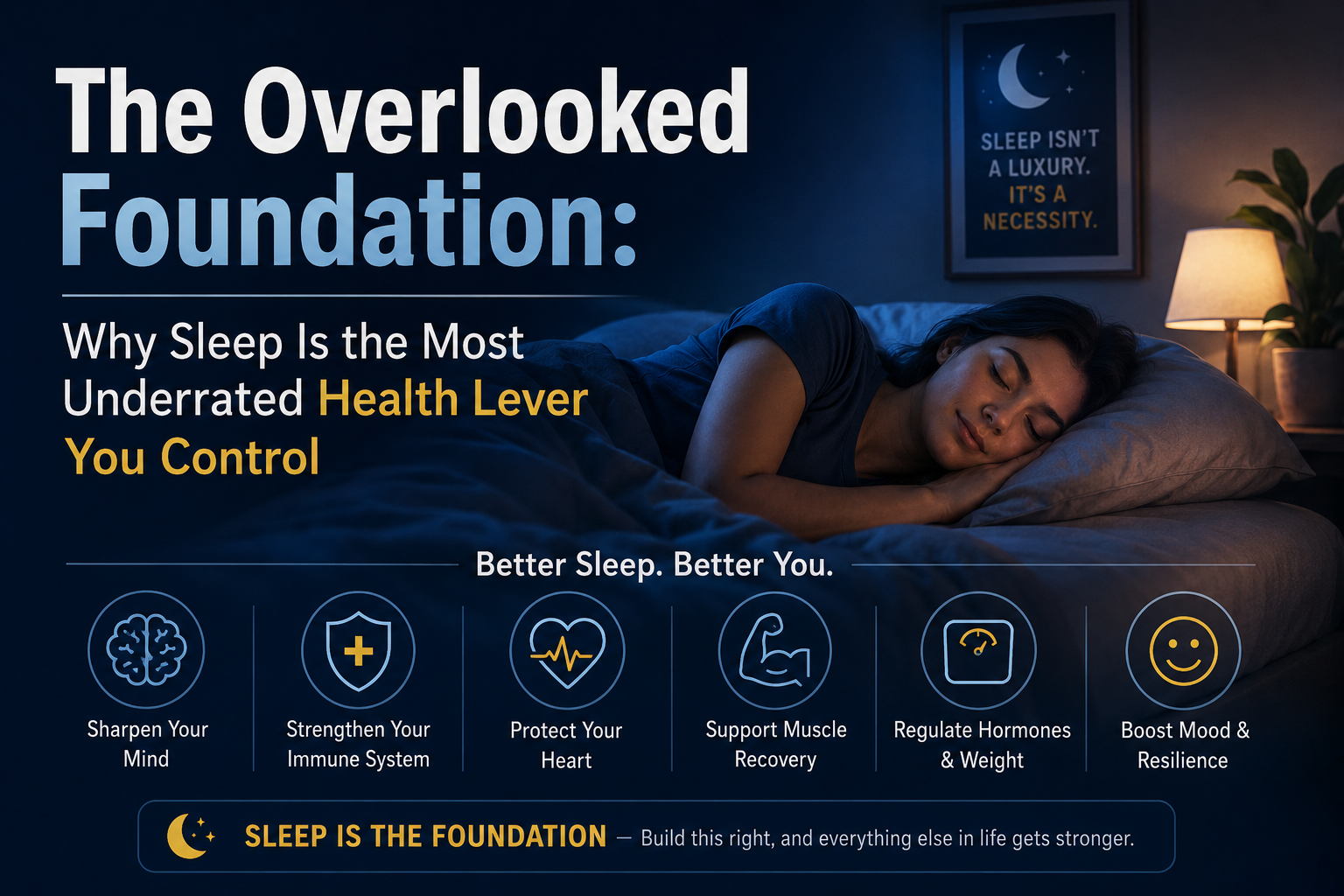
In conversations about health and lifestyle, certain topics receive a disproportionate share of attention. Nutrition generates an entire industry of advice, products, and competing frameworks. Exercise occupies enormous cultural space — from gym culture to running communities to the perennial debate about what kind of movement is most effective. Mental health, increasingly, is being brought into the mainstream of wellness discourse in ways that were largely absent a generation ago.
Sleep, by contrast, is treated as a background variable. It is the thing people mention when they confess to not having enough of it, or the discipline invoked in productivity discussions as a trade-off to be managed. It is rarely approached as what the evidence increasingly shows it to be: the single most foundational biological process underlying virtually every other dimension of physical and mental health. Understanding what sleep actually does — and what disrupting it actually costs — changes the calculus considerably.
What Sleep Is Actually Doing
The popular conception of sleep as a period of inactivity is almost completely wrong. Sleep is a period of intense, highly organised biological work. During the deeper stages of slow-wave sleep, the body undergoes physical repair: cellular damage is reversed, immune function is consolidated, tissue is rebuilt, and growth hormone is released. The cardiovascular system uses the relative rest of deep sleep to reduce inflammation and regulate blood pressure. The endocrine system recalibrates hormonal balances that govern appetite, stress response, and glucose metabolism.
In the brain, sleep performs functions that are even more significant and less well understood by the general public. The glymphatic system — a waste-clearance network in the brain that operates primarily during sleep — removes metabolic byproducts, including the amyloid plaques associated with Alzheimer's disease progression. The hippocampus consolidates memories formed during waking hours, transferring them to long-term storage. Emotional processing occurs during REM sleep, with the brain effectively regulating the affective charge of difficult experiences — a process that explains, in part, why a night of disrupted sleep leaves people emotionally reactive and cognitively impaired in ways that a short-term fast or a missed workout does not.
The Specific Costs of Chronic Sleep Insufficiency
The evidence on the consequences of chronic sleep insufficiency — defined broadly as consistently sleeping fewer than seven hours per night for adults — is now extensive and unusually consistent across research methodologies. The costs are not confined to tiredness. They are systemic.
Cardiovascular risk: Multiple large-scale studies have found that consistently sleeping six hours or fewer per night is associated with significantly elevated risk of hypertension, coronary artery disease, and stroke. A 2023 analysis of data from the UK Biobank, covering over 400,000 participants, found that short sleep duration was among the most significant lifestyle predictors of cardiovascular events — comparable in magnitude to smoking or physical inactivity.
Metabolic function: Sleep restriction disrupts the hormones that regulate appetite — increasing ghrelin (which drives hunger) and reducing leptin (which signals satiety). It also impairs insulin sensitivity, increasing risk of type 2 diabetes. Research participants restricted to four to five hours of sleep for as little as five consecutive days showed metabolic profiles comparable to pre-diabetic states. Restoration of normal sleep reversed these changes — but gradual, chronic restriction produces effects that are less obviously reversible.
Mental health and cognitive function: The relationship between sleep and mental health is bidirectional and powerful. Disrupted sleep increases risk of depression and anxiety disorders; depression and anxiety in turn disrupt sleep. But even without clinical diagnosis, chronic sleep insufficiency reliably degrades working memory, executive function, emotional regulation, and decision-making quality. In a work and life context where these capacities are constantly called upon, the cost of operating on insufficient sleep is both real and largely invisible to the individual experiencing it — because sleep deprivation impairs the metacognitive ability to accurately assess one's own cognitive impairment.
What Actually Disrupts Sleep — and What Helps
In Pakistan's urban environment, several specific disruption factors are particularly prevalent. Evening screen exposure — from smartphones, laptops, and television — delays circadian sleep onset by suppressing melatonin production in response to blue-spectrum light. Irregular sleep and wake schedules, common among shift workers and in households with young children, fragment the sleep architecture that makes deep and REM stages accessible. Stress — particularly the unresolved, anticipatory kind common in high-pressure work environments — activates the HPA axis in ways that are physiologically incompatible with sleep onset and maintenance.
The evidence-based responses to these disruption factors are not complicated, though they require consistency. Consistent sleep and wake times — including on weekends — are among the most powerful regulators of circadian rhythm available. Reducing screen exposure in the hour before sleep, or using blue-light filtering, materially improves sleep onset. A room environment that is cool, dark, and quiet addresses three of the most reliable physical barriers to sleep depth. And developing a wind-down routine — some form of transition between the demands of the day and the conditions of sleep — reduces the cognitive activation that keeps people awake after they intend to sleep.
None of these interventions requires purchasing anything. They require attention to the structure of the day's end — a form of intentional design applied to the most biologically valuable hours in a twenty-four-hour cycle.
Sleep is not what remains after everything else has been fitted in. It is the foundation that makes everything else possible. Treating it that way changes what the rest of the day looks like.
What is the one thing most consistently getting between you and a genuinely good night of sleep? We want to understand the actual landscape — share below.