
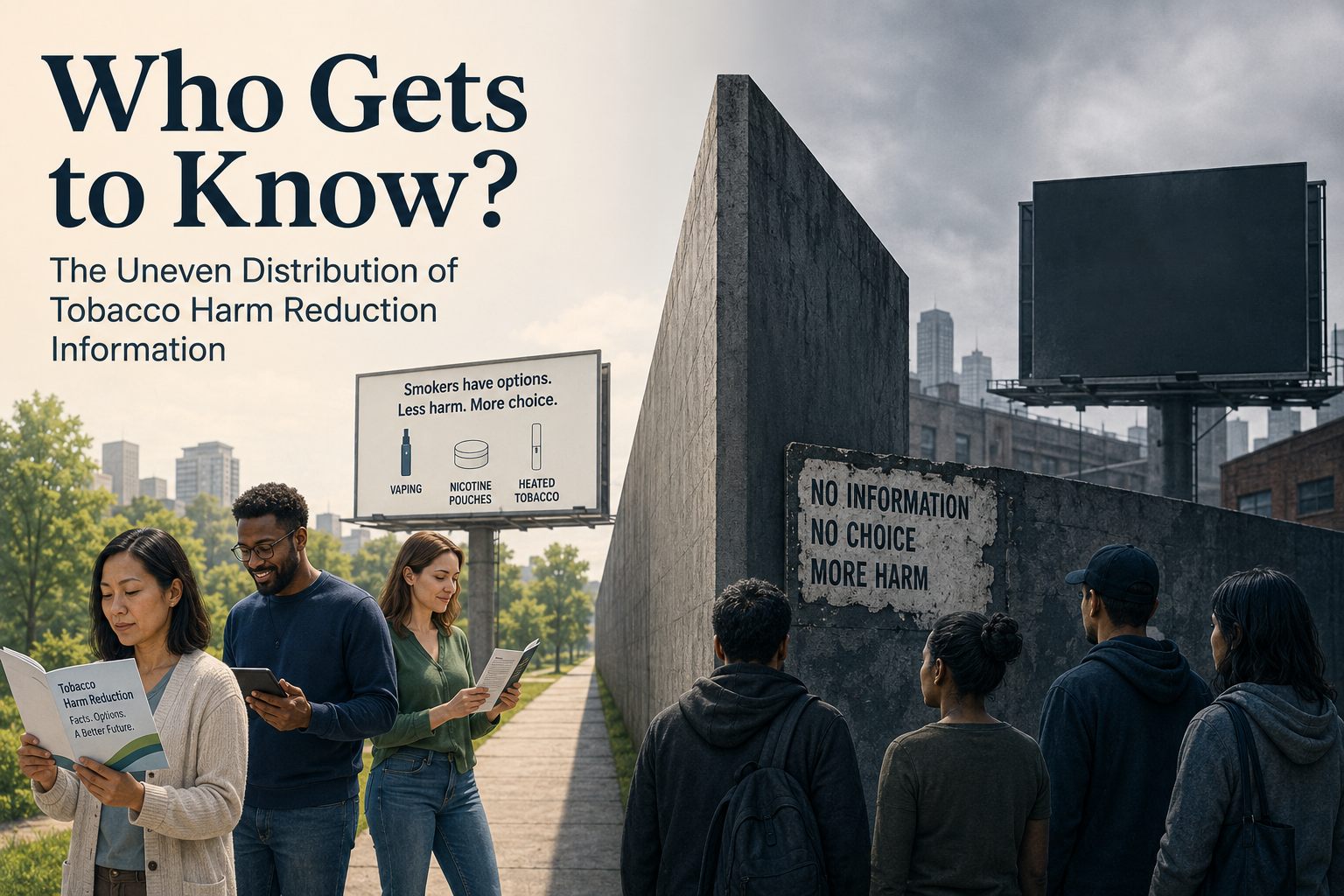
Harm reduction, as a concept, rests on a deceptively simple premise: that reducing the harm associated with a behaviour is a legitimate and valuable goal, even when eliminating the behaviour entirely is not immediately achievable. This premise is well-supported by evidence, broadly accepted in medical literature, and central to how many of the most effective public health interventions of the past several decades have been designed. And yet, in the context of tobacco, the application of this principle is strikingly uneven — not just across countries, but within them.
In Pakistan, as in many developing economies, the question of who has access to harm reduction information — and who does not — is not merely academic. It is a question that maps almost directly onto existing inequalities of class, geography, gender, and education. Understanding those fault lines is not pessimistic. It is the necessary starting point for addressing them.
Bridging Information and Public Health
As discussions around tobacco harm reduction continue to evolve, healthcare professionals emphasize the importance of balancing youth protection with support for adult smokers who would otherwise continue using combustible cigarettes.
“Pakistan faces a dual responsibility: protecting young people from nicotine addiction while supporting millions of adult smokers in reducing their health risks. Effective regulation must strike this balance through strong enforcement and evidence-based differentiation between products.”Dr. Prof Abdul Rasheed Khan, Cardiologist
The Geography of Information
In Pakistan's major urban centres — Karachi, Lahore, Islamabad, Peshawar — a literate adult with internet access and some degree of health literacy can, with effort, find credible information about tobacco harm reduction. That information may be fragmented, partly in English, and filtered through a public health framework that does not always distinguish clearly between different types of tobacco products. But it is, in principle, accessible.
In secondary cities, small towns, and rural areas, this picture changes substantially. Health literacy is lower, healthcare provider density is lower, and the dominant information channels — family networks, local media, community religious leaders — are not typically engaged with evidence-based tobacco harm reduction. For adults in these settings who use tobacco and who might benefit from switching to a less harmful product, the practical reality is that no accessible, accurate information channel exists. The default, by absence, is continued combustible cigarette use.
A 2024 survey by the Pakistan Alliance for Nicotine and Tobacco (PANT) found that fewer than 12% of tobacco users in non-urban settings were aware of any alternative nicotine delivery system beyond cigarettes and smokeless tobacco. Awareness did not correlate with willingness to switch — but it correlated almost perfectly with the opportunity to consider doing so.
The Economic Dimension
The equity gap in harm reduction is not only geographical. It is also economic. In Pakistan's tobacco market, premium non-combustible alternatives — heated tobacco devices, quality e-cigarettes, pharmaceutical NRTs — carry a price premium that places them out of reach for a large proportion of daily tobacco users. The consumers most exposed to cigarette-related health harm — those who smoke the most, in the lowest-income brackets, with the least access to healthcare — are precisely the consumers who face the highest barriers to accessing affordable alternatives.
This is not a problem unique to Pakistan. In the United Kingdom, early data on vaping uptake showed a similar socioeconomic gradient, with higher-income smokers switching at greater rates than lower-income ones. But the UK has progressively addressed this through subsidised NRT provision, smoking cessation services, and targeted public health communication. In Pakistan, no comparable infrastructure exists. The absence is not neutral. It is a policy choice with health consequences that fall disproportionately on those who are already most vulnerable.
Gender and the Invisibility Problem
The equity analysis of tobacco harm reduction access in Pakistan must also account for gender — and specifically for the ways in which female tobacco use remains largely invisible in public health discourse. Female tobacco use in Pakistan, while underreported, is significant, particularly in the form of smokeless tobacco in rural and semi-urban populations. But because female tobacco use carries heavy social stigma, it is rarely discussed openly — and the information architecture built around tobacco harm reduction does not, in most cases, address women directly.
This invisibility has practical consequences. Women who use tobacco in stigmatised contexts are less likely to seek cessation support, less likely to discuss their use with healthcare providers, and less likely to have access to harm reduction information that acknowledges their situation. Harm reduction, as it is currently communicated in Pakistan, is implicitly addressed to men. The field of potential harm reduction — for female tobacco users — is largely unmapped.
What Equitable Access Would Look Like
Equitable access to tobacco harm reduction information would require, at minimum, several things. It would require information to be communicated in Urdu and regional languages, not just English. It would require that information channels extend beyond social media and online platforms — which reach an educated, urban, relatively affluent demographic — into community health settings, pharmacies, and local media. It would require that harm reduction conversations address the full spectrum of tobacco users in Pakistan, including women, lower-income users, and rural populations. And it would require that affordability be recognised as a determinant of access, not simply a market variable.
None of this is beyond reach. But it requires acknowledging, first, that the current distribution of harm reduction information is not equitable — and that inequity has health costs that are borne by those least able to bear them.
Access to accurate health information is not a consumer perk. It is a foundation of informed adult decision-making. When that access is unevenly distributed, the consequences are unevenly distributed too.
Where do you think the information gap around tobacco harm reduction is most pronounced in communities you know? Share below — your perspective helps shape what we cover.