
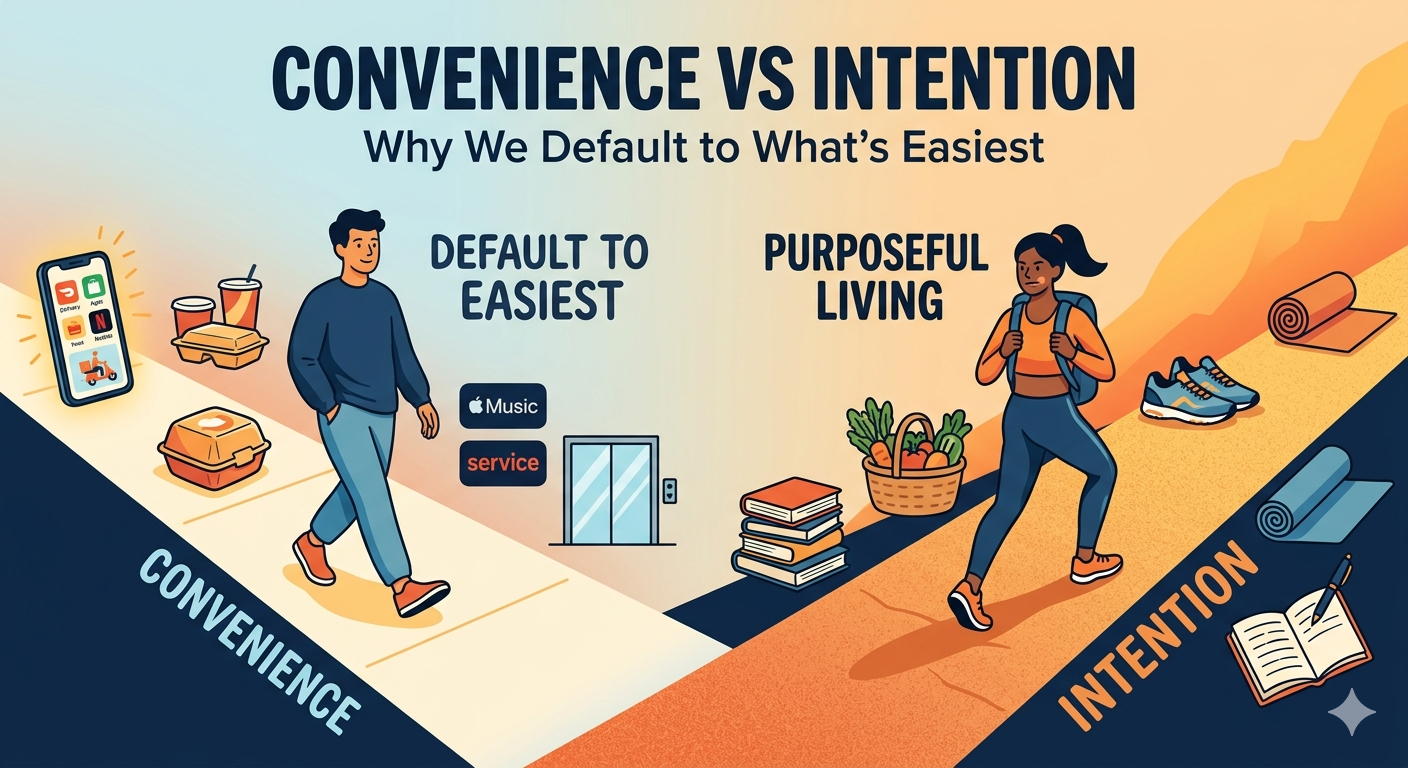
There is a particular kind of frustration that comes from knowing what you want to do and consistently not doing it. You intend to sleep earlier. You intend to eat more carefully. You intend to move more, to check your phone less, to respond with patience rather than irritation. And yet day after day, the day unfolds in ways that seem to bypass your intentions and arrive, without much drama, at whatever has always been most convenient.
This is not a character problem. It is an attention problem — and, more specifically, it is a problem of competing defaults. We human beings are extraordinarily efficient at doing what we have always done, in the way we have always done it, because cognition is expensive. The brain conserves energy by automating repeated behaviour. And automation almost always favours the path of least resistance: the nearest option, the familiar choice, the sequence that requires no deliberation.
What that means, practically, is that intention alone is a weak competitor against a well-established habit. If we want to live with more conscious choice — if we want intention to have a real effect on behaviour — we need to understand not just what we want, but how the ordinary architecture of our day either supports or undermines it.
The Gap Between Intention and Action
Psychologists have studied the gap between what people intend to do and what they actually do for decades. The phenomenon is consistent enough to have a name: the intention-action gap. It describes the well-documented reality that forming an intention is, on its own, a poor predictor of subsequent behaviour. Studies in health psychology consistently find that the correlation between stated intention and actual behaviour change is moderate at best — typically explaining less than a third of the variance in behaviour.
The reason is not that people are dishonest about their intentions. It is that the conditions under which they act are rarely identical to the conditions under which they set intentions. Intentions are usually formed in moments of reflection: a quiet evening, a conversation with a doctor, a health scare, a new year. Behaviour happens in the middle of everything else: the morning rush, the afternoon slump, the social situation with its own gravity, the stress that overrides the plan.
In Pakistan's urban environment — where working hours are long, commutes are demanding, and the separation between personal time and professional obligation is often unclear — this gap is especially pronounced. The conditions for reflective intention-setting and the conditions for everyday action-taking are rarely the same. And when they diverge, convenience usually wins.
What Defaults Are, and Why They Matter
A default is what happens when we do not actively decide otherwise. It is the food that gets eaten because it is already there. It is the tab that gets opened because the browser remembers it. It is the coping mechanism that activates because it has activated before in similar circumstances. Defaults are not conscious choices. They are the residue of past choices — the behaviour that remains when the capacity for active decision-making is not engaged.
The trouble is that defaults are rarely examined. They operate below the level of active attention, which means we often do not notice when they are shaping our behaviour in ways that conflict with our intentions. A person may intend to eat more healthily and not notice that the configuration of their kitchen makes unhealthy options consistently easier to access. A person may intend to use their lunch break to take a walk and not notice that their desk and phone make it nearly impossible to step away. The default, operating quietly, overrides the intention before the intention even fully forms.
This is the subtle but important connection between conscious lifestyle design and harm reduction thinking. In both cases, the insight is the same: the easier an option is to access, the more likely it is to be chosen. If we want people to have genuine access to better choices — whether in diet, in sleep, in activity, or in risk-related behaviour — we need to think not only about what choices are available, but about how easy they are to reach in the ordinary flow of a day.
Reclaiming the Default: Practical Redesign
The good news is that defaults are not fixed. They can be redesigned. And redesigning them does not require willpower. It requires a different kind of effort — the kind that happens once, in advance, so that the automatic version of the day already points in a better direction.
Behavioural scientist BJ Fogg describes this as 'redesigning the environment so the desired behaviour is the path of least resistance.' In practical terms, this might mean placing a water bottle where a sugary drink used to be. It might mean scheduling an evening walk at a specific time rather than leaving it for 'when there's time.' It might mean having a pre-agreed conversation that changes the shared default with a partner or housemate. It might mean making the less harmful option the one that is already present, rather than the one that requires a separate trip or deliberate effort.
The insight here is not new. Economists Thaler and Sunstein, in their foundational work on 'nudge theory,' showed that default settings in everything from retirement savings to organ donation to cafeteria food layout produced major shifts in population-level behaviour without any coercion or enforcement. The architecture of the choice mattered more than the stated preference of the individual. What was defaulted in was chosen far more often than what required an active opt-in.
For anyone thinking seriously about intentional living, this is both sobering and empowering. It is sobering because it reminds us how much of our behaviour is not really chosen at all. It is empowering because it means that thoughtful, one-time redesign of our environments and routines can produce lasting changes that do not depend on constant effort or motivation.
Intention Without Judgment
There is an important qualification to all of this: conscious living does not mean perfect living. The goal is not to construct a life so optimised that there is no room for flexibility, impulse, or rest. That way lies a different kind of rigidity. The goal is simply to ensure that the direction of the day — the path most likely to be followed when attention is not fully engaged — is one we have had some say in setting.
That is a more honest framing of intentional living. It does not demand that every moment be purposeful. It asks only that some thought be given to what the ordinary, inattentive, automatic version of the day looks like — and whether that version serves us as well as we would like.
For many people, answering that question honestly is, in itself, a form of conscious choice. It is the beginning of the kind of change that does not require heroic effort — because it has been built into the structure of ordinary life.
Where in your day does convenience most consistently beat intention? And what would it take to shift that balance, even slightly? Share below.