
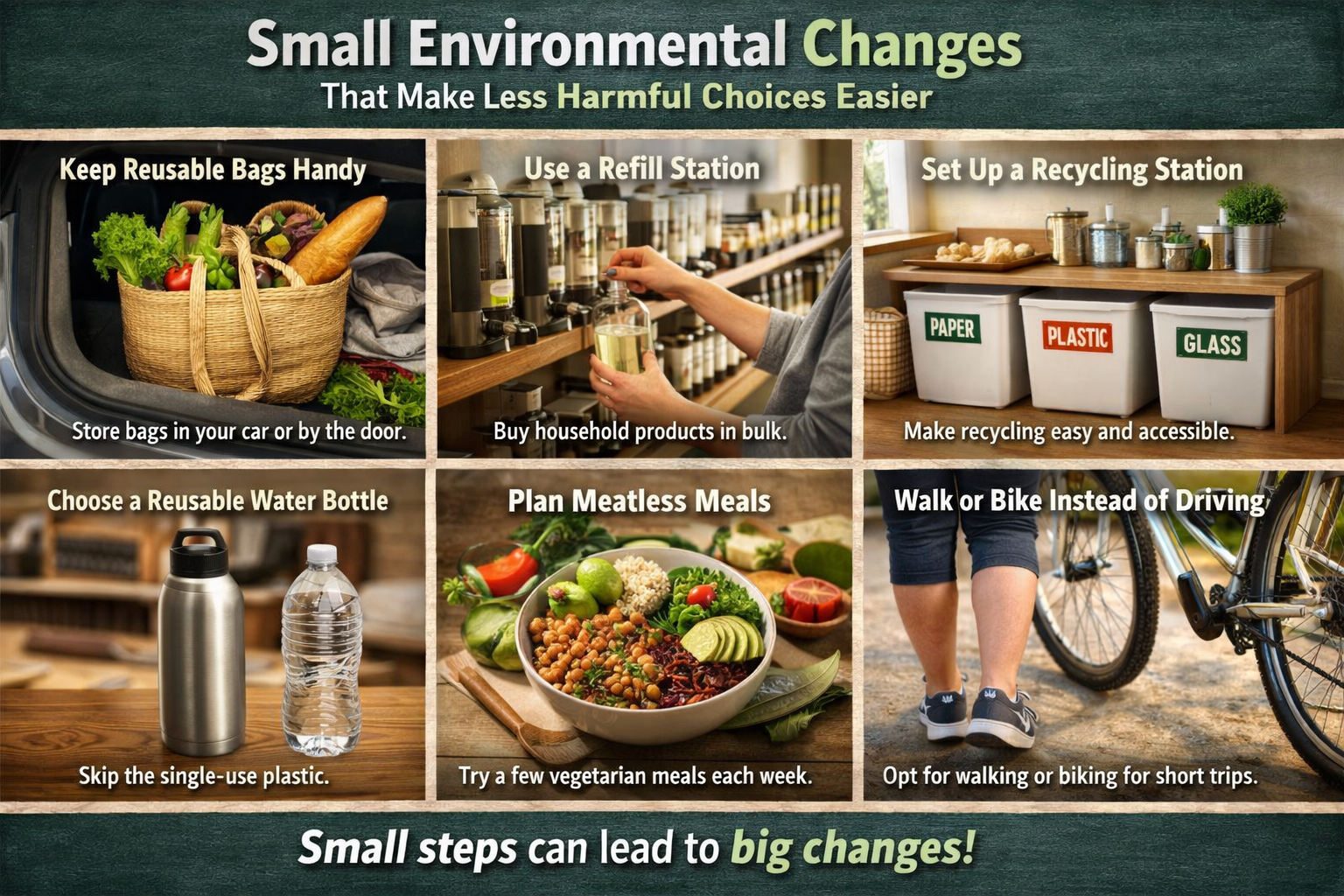
We often imagine change as a dramatic act of self-reinvention. A stronger mindset. A new level of discipline. A sudden break with old habits. But in everyday life, progress usually depends less on dramatic intention and more on small systems. The way a kitchen is arranged, the rhythm of a morning, the visibility of a water bottle, the timing of a break, the ease of access to less harmful options, these quiet details often shape behaviour more than motivational speeches ever do.
This is good news because systems are easier to work with than self-judgment. They allow us to improve life through design rather than through constant internal battle. When a less harmful choice becomes easier, more visible, and more natural, it stops relying on perfect motivation. It becomes part of the flow of the day.
The Power of the Invisible Hand: How Environments Steer Behaviour
People usually do what their environment makes easy. If fruit is washed, cut, and placed where it can be seen, it is more likely to be eaten. If a phone is within reach at bedtime, sleep is more likely to be interrupted. If work routines offer no pause except the most familiar one, old coping patterns take over. This is not weakness. It is the normal interaction between human attention and environmental design.
The behavioural science behind this is clear. Habits are cue-driven responses. The brain learns patterns. A place, a time of day, a social setting, or a feeling such as stress or boredom can become a prompt. Over time, the environment starts doing part of the decision-making for us. That is why a behaviour can feel automatic even when a person no longer feels fully aligned with it.
In Pakistan, the environmental dimension is especially important because behaviour is often deeply social. Home life is shared. Workplaces are collective. Tea stalls, drawing rooms, weddings, and informal gatherings all come with powerful scripts. Many behaviours are tied not only to individual preference but to atmosphere and belonging. A cigarette may not appear to someone simply as a product. It may be linked to routine, masculinity, rest, social rhythm, or relief. If that context stays intact, change becomes harder. The issue is not only the person. It is the ecosystem around the person.
Stress and Environment: A Perfect Storm in Urban Life
Stress makes this even more pronounced. Under pressure, human beings usually do not choose what is best in theory. They choose what is familiar, fast, and available. When an environment offers frictionless access to an old habit and very little support for a less harmful one, the environment will usually win. This is why guilt-based messaging often falls flat. It speaks to intention while ignoring the architecture of behaviour.
A 2023 study in Tobacco Control examined environmental influences on tobacco use in urban Pakistan and found that workplace and home settings with normalized smoking cues (shared breaks, visible packs, social acceptance) significantly increased continued use, even among those who expressed intent to reduce. The researchers estimated that environmental cues account for up to 60% of relapse risk in high-stress urban settings .
In Karachi’s densely populated neighbourhoods, where many spend long hours commuting or working in shared spaces, the environment often reinforces the very habits people want to change. A 2024 cross-sectional survey from the Aga Khan University in Karachi showed that smokers in open-plan offices or roadside shops were 2.8 times more likely to smoke during breaks compared to those in smoke-free indoor environments.
From Internal Battle to Environmental Support
Once we understand this, the conversation becomes more humane and more practical. Instead of asking only, “Why did this person not change?”, we start asking better questions. What cues keep this behaviour active? What settings make it harder? Where does stress peak? What social expectations are operating? What would make a less harmful choice easier to reach, easier to repeat, and easier to sustain?
For tobacco harm reduction, this shift in perspective matters. People do not make decisions about smoking in abstract moral space. They make them in homes, workplaces, commutes, and social environments. If the only visible option in those spaces is the combustible cigarette, then the path of least resistance remains the most harmful one. But if people are given clearer information, reduced stigma, and practical alternatives that fit real life, the environment begins to support movement rather than trap it.
This is not about pretending that environment explains everything. Personal agency still matters. But agency works best when it is supported rather than constantly opposed. A person trying to make a less harmful choice should not have to fight every cue, every routine, and every social pressure at once. Real change becomes more possible when the environment is redesigned, even slightly, in favour of that change.
Modest Openings That Create Real Momentum
That redesign can begin with very small shifts. A different break routine. A different cue after meals. A conversation at home that lowers pressure instead of raising it. A workplace culture that does not romanticise smoking as relief. Better product information. More realistic public education. Less judgment and more structure. These changes may sound modest, but behaviour often moves through modest openings .
A 2024 pilot study in Lahore demonstrated that simply introducing visible, non-judgmental information about harm reduction alternatives in workplace break areas increased interest in exploring options by 42% among smokers who previously avoided discussion due to stigma.
When we understand that behaviour is contextual, we stop seeing struggle as proof of failure. We begin to see it as a signal that the environment may be doing more than we realised. That is a more intelligent way to think about health, and a more compassionate way to think about change. People do not just need motivation. They need conditions that make less harmful choices easier to live with.
What small change in your daily environment has made a difference for you? Share below or explore our resources on designing supportive spaces for less harmful living.