
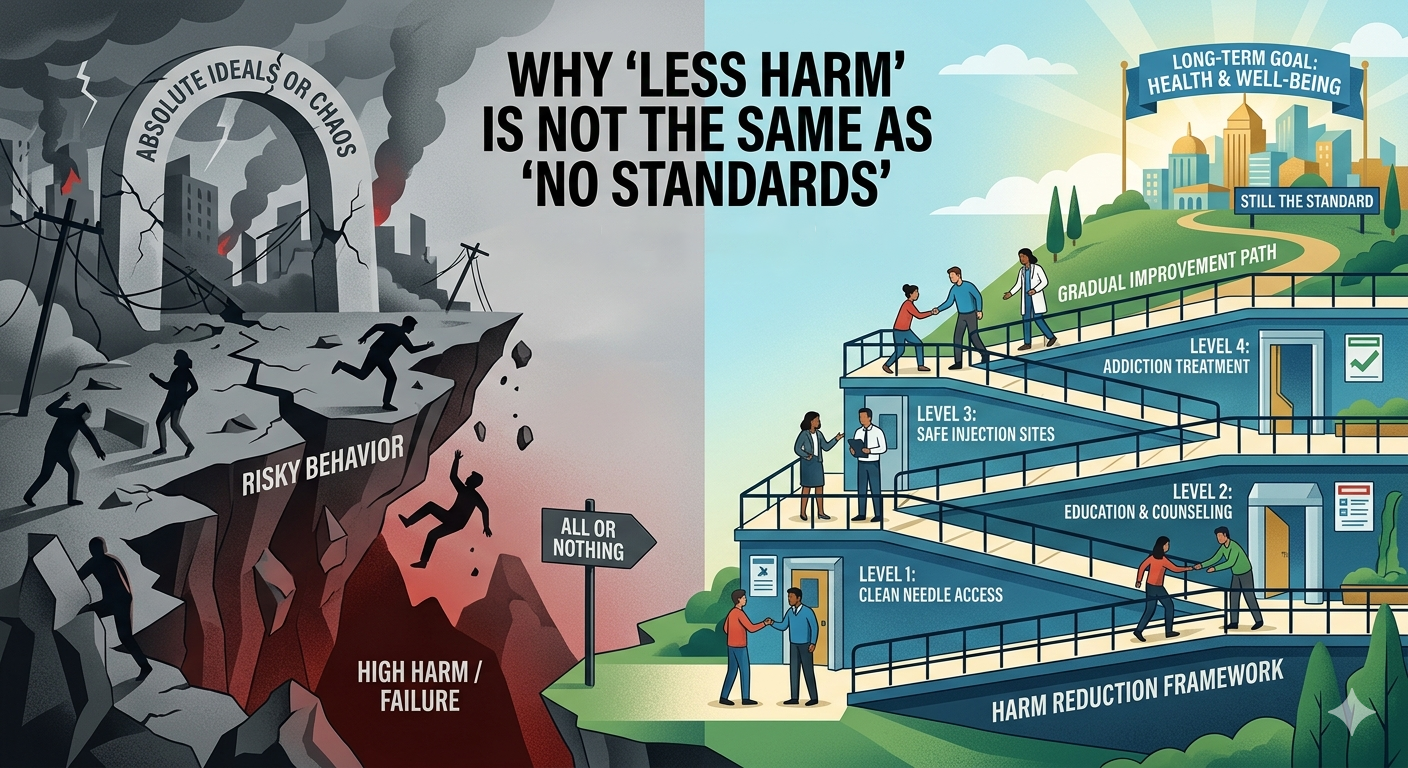
One of the most persistent misunderstandings in public health is the idea that reducing harm means lowering standards. It is often spoken about as though it were a compromise of principle, a softening of resolve, or a quiet surrender to behaviour that should simply disappear. In this framing, anything short of the ideal outcome is treated with suspicion. If the best possible result is not achieved immediately, then the next-best route is assumed to be ethically weak or strategically flawed. But that is not what harm reduction means.
Harm reduction does not abandon standards. It does not ask us to stop caring about risk, health, responsibility, or good regulation. What it does ask is something far more difficult and far more serious: how do we reduce damage in the real world while people, systems, and behaviours remain imperfect? How do we respond to risk as it actually exists, rather than as we wish it existed? And how do we protect people meaningfully when ideal outcomes may take time, may happen gradually, or may not happen in a single linear step?
These are not low-standard questions. They are rigorous ones. They require realism, nuance, and the willingness to think strategically instead of symbolically.
We Already Use Reduction Logic Everywhere Else
The truth is that we already accept this logic in many other areas of life. Seatbelts do not celebrate car crashes. Helmets do not endorse motorcycle accidents. Water treatment does not imply that contamination is acceptable. Childproof packaging does not encourage carelessness. Speed limits, food safety protocols, disaster preparedness systems, workplace safety equipment, and infection-control procedures all work from the same basic principle: risk exists, and serious societies try to reduce the damage it causes.
No one looks at a life jacket and assumes it is an invitation to drown. No one sees flood barriers and concludes that planners have given up on climate resilience. The existence of protective measures does not signal moral weakness. It signals responsibility. It shows that we understand the world as it is, not just as we would like it to be.
That is what responsible design does. It does not wait for perfect conditions before acting. It puts protection in place because the consequences of unmanaged risk are too great.
Public health should be understood in the same way. It should not be embarrassed by practical measures simply because they deal with imperfect reality. In many cases, the most serious and mature response to risk is not to deny complexity, but to design around it.
When the Conversation Becomes Moral Instead of Strategic
The problem begins when public conversation becomes moral rather than strategic. In a moralised frame, only the ideal outcome feels respectable. Anything less is treated as failure. Every intermediate gain becomes suspect because it is not complete. Every practical step is measured against perfection rather than against the harm it actually prevents. The tone may sound principled, but the results are often counterproductive.
This way of thinking can create a strange and dangerous rigidity. It can make people more invested in symbolic purity than in practical protection. It can encourage public messaging that sounds forceful, clear, and morally satisfying, while failing to reduce real-world damage. And worst of all, it can leave people trapped in the most dangerous version of a behaviour because the safer route is dismissed for not being perfect enough. That is not strategy. It is often a refusal to engage with how behaviour actually changes.
Human beings rarely move through change in clean, direct, idealised ways. Most people do not wake up one morning, abandon all harmful habits, and proceed in a straight line towards better health. They move through stress, social pressure, routine, dependency, fear, misinformation, trial and error, setbacks, and partial progress. They may take one step forward and then hesitate. They may need multiple attempts. They may respond to what is practical before they respond to what is ideal. A public health framework that cannot recognise this does not become stronger. It becomes detached.
Why This Matters So Much in Tobacco
Tobacco offers one of the clearest examples of why reduction logic matters. The greatest health burden comes from combustible smoking because burning tobacco produces toxic smoke. That smoke contains the substances most closely associated with serious disease. From a harm reduction perspective, that distinction matters enormously. It means that not all nicotine-related behaviours carry the same level of danger, and it means that the route through which a product is used can make a substantial difference to risk.
This is where realism becomes essential. If an adult who would otherwise continue smoking moves away from combustion towards a less harmful alternative, the standard has not disappeared. The objective remains serious and fully intact: reduce disease risk, reduce toxic exposure, and create the conditions for better health outcomes over time. What changes is the path.
Instead of pretending that only one type of progress counts, harm reduction recognises that lower-risk movement can still be meaningful, protective, and worth supporting. It does not say the journey is complete. It says the direction matters. And in public health, direction matters a great deal when it meaningfully lowers the scale of harm.
That distinction is especially important because public debate often collapses risk into absolutes. Either something is portrayed as safe, or it is portrayed as equally dangerous. But that is not how health risk works in reality. Many things exist on a spectrum. Two behaviours can both carry risk and still not carry the same risk. Two products can both require scrutiny and still not pose equal danger. If policy and communication refuse to recognise degrees of harm, then they risk becoming intellectually weak even while sounding morally confident.
Why Realism in Public Health Matters in Pakistan
In Pakistan, where health systems are strained, information is uneven, and behaviour is shaped by strong social, economic, and cultural pressures. This kind of realism matters especially in places like
In such settings, public messaging that ignores lived reality may sound forceful, but forceful messaging is not the same as effective strategy. People do not make decisions in a vacuum. They make them through habit, affordability, stress, misinformation, access, stigma, and what feels possible in everyday life. A framework that refuses to engage those realities may protect its moral posture, but it may fail to protect people.
That failure is not abstract. If the only respectable story offered to people is total transformation, then those who cannot make that leap immediately may remain with the most harmful option for far longer. If all nuance is treated as weakness, the result may not be higher standards. It may simply be fewer workable pathways away from the greatest damage.
Pakistan, like many countries, needs health thinking that is both principled and practical. It needs communication that respects evidence and human behaviour at the same time. It needs systems that understand that people often move through change unevenly. And it needs a public discourse mature enough to distinguish between endorsement and risk reduction, between lower harm and no standards, between realism and surrender.
Standards Guide the Destination, Realism Shapes the Route
That is why reduction logic matters. It does not tell people to settle. It does not ask institutions to become careless. It does not treat risk lightly. What it does is insist that public health pay attention to what actually lowers harm. It reminds us that progress can be serious, evidence-led, and incomplete at the same time. It rejects the false choice between idealism and pragmatism and asks the two to work together.
So, when we say that less harm is not the same as no standards, we are saying something quite simple. Standards should guide the destination. Realism should shape the route. A person does not need to be perfect for a public health intervention to help them. A better option does not need to be flawless in order to be meaningfully better than the worst one. And a serious society should be able to understand that distinction.
Public health fails when it confuses symbolic purity with practical protection. Harm reduction, at its best, is neither moral panic nor moral surrender. It is disciplined realism in service of better outcomes. And in the real world, better outcomes matter.
What does “realistic progress” look like in your life? Share your thoughts below or explore our resources on harm reduction done right.