
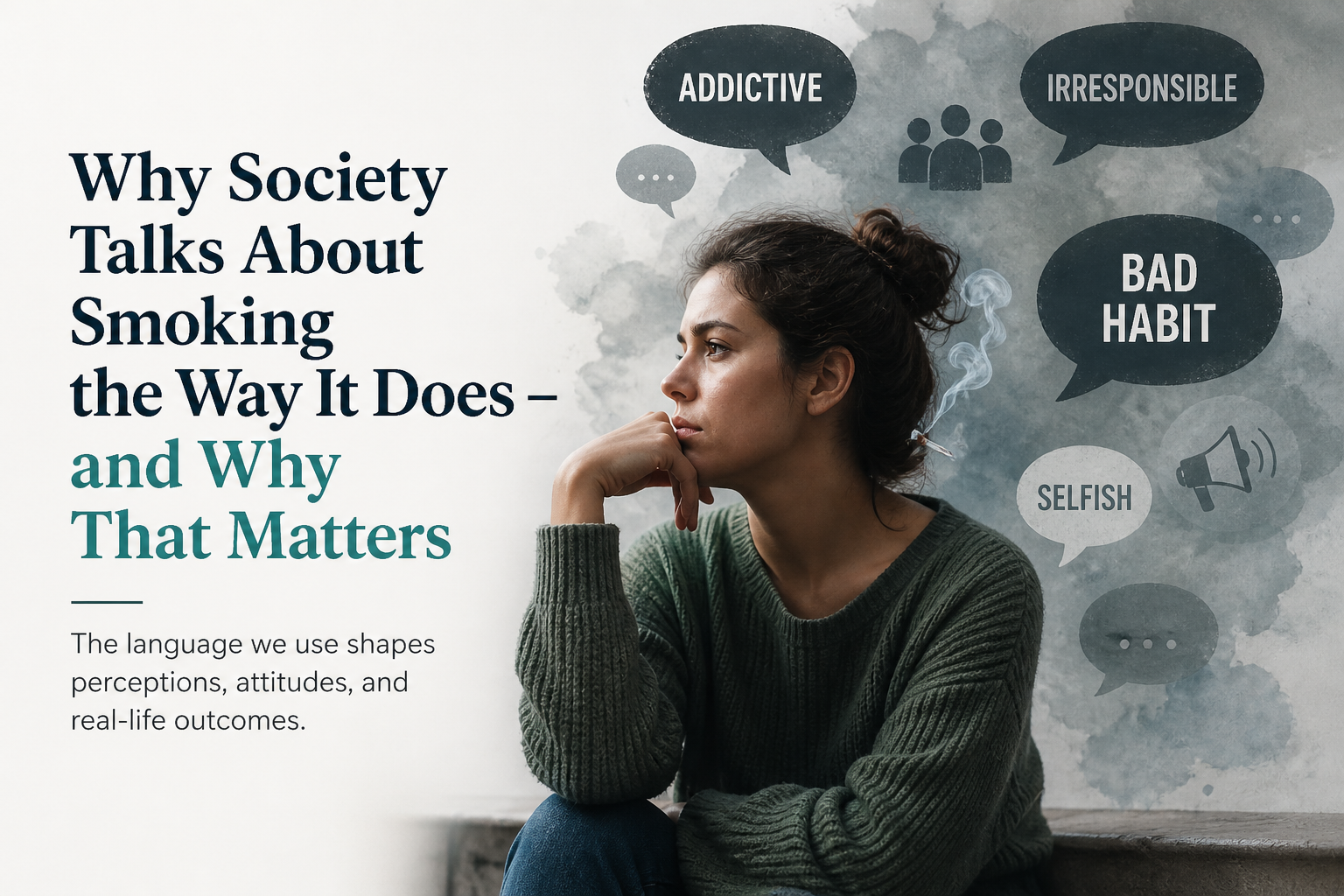
There is a particular tone that enters most conversations about smoking. It carries judgment in it even when the speaker is trying to be helpful. It often treats smokers as people who lack self-respect, or who simply have not been told the right facts, or who are choosing to ignore what is clearly in their best interests. In Pakistan – as in most countries – this tone is woven deeply into health campaigns, family conversations, and popular culture. And it is worth pausing to ask: does it work? Does social disapproval of smoking actually produce less smoking? Or does it produce something else entirely?
This article does not argue that smoking carries no risks. It carries serious risks. That is not in question. What is in question is whether stigma – the social punishment of a behaviour through shame, exclusion, and moral labelling – is an effective strategy for supporting people who want to change. The evidence suggests it is not. In fact, stigma may be one of the most reliable ways to ensure that adults who use tobacco remain trapped in the most harmful version of that behaviour, and that harm reduction remains inaccessible to the people who need it most.
The Social Mechanics of Stigma
Stigma is not simply criticism. It is a social mechanism that assigns a moral identity to a person based on a single attribute or behaviour. When smokers are consistently described in dehumanising or reductive terms – as weak-willed, irresponsible, or a burden – the message received is not simply 'this is dangerous.' The message is 'you are a lesser person for doing this.' That is a fundamentally different kind of communication.
Erving Goffman's foundational work on stigma describes how socially marked individuals often respond through concealment, withdrawal, or what he calls 'passing' – attempting to hide the stigmatised trait in social contexts. In the context of tobacco, this plays out vividly. Smokers may avoid conversations about their habit, decline to discuss alternatives with healthcare providers, or reject information about harm reduction simply because engagement with that information confirms an identity they are working to hide. The stigma does not push them toward change. It pushes them toward invisibility.
A 2023 systematic review in Nicotine & Tobacco Research found that health-related stigma was consistently associated with reduced likelihood of seeking support or engaging with cessation or harm reduction services. The mechanism was not surprise: stigma increased psychological distress, which in turn reinforced dependence on nicotine as a coping tool. The very shame intended to motivate change amplified the emotional need the habit was already serving.
How This Plays Out in Pakistan
In Pakistan, the dynamics of stigma around tobacco are shaped by intersecting cultural, gender, and class pressures. Smoking among men in many social settings is normalised or even associated with a particular version of masculinity. At the same time, female tobacco use – though significant, particularly in the form of smokeless products in rural areas – is heavily stigmatised and therefore underreported, under-discussed, and largely invisible in public health conversations.
This inconsistency creates a fragmented social reality. In spaces where smoking is normalised, stigma is largely absent, and with it, so is honest conversation about risk and alternatives. In spaces where smoking is moralised, shame is present but support is not. In both cases, the conditions for genuine, informed decision-making are poorly served.
A 2024 qualitative study from the University of Peshawar on tobacco use among urban working adults found that more than 70% of participants had never discussed their tobacco use with a healthcare provider. The most cited reason was not lack of access, but anticipation of judgment. They expected to be lectured, shamed, or dismissed. So they said nothing. And in the silence, nothing changed.
The Relationship Between Stigma and Information
When stigma closes off honest conversation, it also closes off access to accurate information. This is particularly damaging in the context of tobacco harm reduction, where the distinction between combustible and non-combustible products is essential knowledge. A person who has been taught that all nicotine use is equally shameful has no useful framework for evaluating alternatives. For them, the question is not 'what is the least harmful option?' but 'how do I avoid being seen as the kind of person who uses these products at all?'
This is not a failure of personal reasoning. It is a predictable consequence of a public conversation that has not made space for nuance. When health communication is built primarily on fear and shame, it crowds out the evidence-based, comparative risk information that adults need to make meaningful choices. And when that happens, the best-informed consumers are usually the ones who have found a way to engage with the topic despite social pressure – not because of it.
Public Health England's framework for tobacco harm reduction communication explicitly cautions against stigmatising language, noting that it creates 'barriers to engagement with health services and harm reduction alternatives among those most at risk.' The U.S. Centers for Disease Control has reached similar conclusions in its guidance for tobacco cessation programmes: non-judgmental, person-centred communication produces significantly better engagement than campaigns built on social disapproval.
A Different Kind of Public Conversation
None of this means that the risks of smoking should be minimised. They should not. But how those risks are communicated matters enormously. A person who feels seen, respected, and accurately informed is far more capable of acting in their own interest than one who feels ashamed and defensive. A health system that treats adults as capable of understanding evidence, rather than as passive recipients of moral instruction, is more likely to produce genuine movement.
In Pakistan, this means building space in public conversation for honest, non-stigmatising discussion of tobacco use, harm, and alternatives. It means ensuring that people who use tobacco have access to accurate comparative risk information, not just warnings. It means designing health communication that respects the social, economic, and emotional complexity of the lives in which tobacco use exists. And it means acknowledging that the person most likely to change their behaviour is not the one who has been most shamed, but the one who has been most clearly and compassionately informed.
How we talk about health choices reflects what we believe about people. And what we believe about people shapes what becomes possible.
What has shaped your understanding of tobacco risks — advertising, family, school, or something else? Share below.